
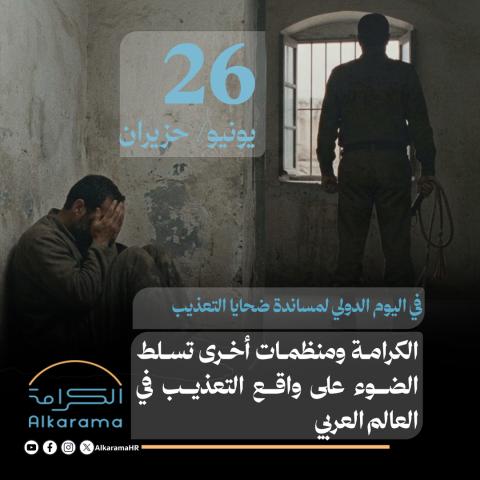
La Journée internationale pour le soutien aux victimes de la torture intervient cette année à un moment charnière, alors que la région arabe est le témoin d'une régression brutale et sans précédent des garanties juridiques fondamentales qui protègent les individus contre les abus. La torture a cessé d'être une pratique isolée ou une violation individuelle soumise à enquête ; dans de nombreux contextes, elle est devenue un instrument structurel, utilisé de manière institutionnelle pour gérer les prisons et les centres de détention, contrôler l'espace public et faire taire les voix dissidentes ainsi que les défenseurs des droits de l'homme.
Les organisations de défense des droits de l'homme soussignées publient cette note d'information à l'occasion de la Journée internationale pour le soutien aux victimes de la torture (26 juin). Conçu comme un document de suivi et de référence juridique, ce rapport vise à exposer les mécanismes de la torture systématique à travers le monde arabe et à mettre en lumière les victimes que les autorités tentent de réduire à des chiffres anonymes derrière les murs des prisons.
Les témoignages et les preuves concrètes et actualisées, recueillis par nos équipes de terrain et nos partenaires, nous imposent de dépasser le langage conventionnel de la condamnation pour activer directement les mécanismes de responsabilité internationale. La torture fait l'objet d'une interdiction absolue en droit international : aucune guerre, aucune polarisation politique et aucun impératif de sécurité ne saurait la justifier.
Afin d'offrir une lecture systématique et une vue d'ensemble exhaustive des dimensions de ce dossier, la présente note d'information aborde la situation actuelle à travers quatre axes principaux :
Le premier examine les réalités de terrain et les pratiques documentées dans la région ;
Le deuxième déconstruit le cadre juridique international régissant le crime de torture ;
Le troisième met en lumière l'architecture de l'impunité qui en garantit la pérennité ;
Le quatrième conclut par les demandes et recommandations urgentes adressées aux décideurs et aux instances internationales.
Premier axe : Faits documentés – Contextes et pratiques de la torture dans la région
À travers ce rapport, nos organisations documentent des méthodes systématiques de torture et de mauvais traitements dans plusieurs contextes arabes. En vertu du droit international humanitaire coutumier et de l'article 3 commun aux Conventions de Genève, l'interdiction de la torture s'impose de la même manière aux États et aux acteurs armés non étatiques :
1. Palestine / Gaza
Dans le contexte de la guerre israélienne en cours à Gaza depuis octobre 2023, nos organisations ont reçu des témoignages crédibles décrivant des actes de torture infligés à des détenus palestiniens dans des centres de détention militaires israéliens. Ces pratiques comprennent des agressions sexuelles, des violences physiques, l'isolement cellulaire prolongé, des humiliations systématiques et le refus de soins médicaux aux blessés. Des organes de l'ONU ont également documenté la détention de professionnels de la santé et de journalistes, en violation directe de la Quatrième Convention de Genève relative à la protection des personnes civiles en temps de guerre.
Les mécanismes de contrôle indépendants restent gravement limités en raison des restrictions imposées par Israël pour accéder aux lieux de détention.
2. Égypte : Une politique de torture et d'abus systématiques et institutionnels
En Égypte, la torture et les mauvais traitements au sein des prisons, des centres de détention et des locaux de la sécurité ont dépassé depuis longtemps le stade des violations isolées ou des violences physiques classiques, pour devenir une politique administrative délibérée, systématique et officiellement cautionnée. L'examen approfondi de ce dossier révèle la mise en place délibérée d'un environnement propice à « l'abus institutionnel ». Dans ce cadre, les failles procédurales et les textes réglementaires sont exploités pour servir de couverture juridique afin de briser physiquement et psychologiquement les détenus, et les dépouiller progressivement de leur humanité à travers trois trajectoires destructrices :
La torture par la négligence (la mort lente) : Elle se traduit par le refus délibéré et systématique de fournir des médicaments et des soins, par l'interdiction des visites familiales et par la transformation des lieux de détention en outils de liquidation physique des détenus politiques sans laisser de traces visibles — au lieu de fonctionner comme des établissements légaux de privation de liberté. Les données de terrain révèlent l'ampleur de cette catastrophe : 1 266 détenus sont morts en prison entre 2013 et 2025 à la suite de tortures et d'une négligence médicale systématique, et 13 décès supplémentaires ont été enregistrés dans les centres de détention au cours des premiers mois de l'année 2025.
La torture par le temps (la punition sans fin) : Elle consiste à détourner la détention provisoire de son statut de mesure judiciaire exceptionnelle pour en faire un châtiment préventif à durée indéterminée qui détruit la vie des détenus. Cela se fait par la pratique de la « rotation » juridique (recyclage de dossiers), par laquelle des individus font l'objet d'un nouveau mandat de dépôt sous de fausses accusations dès qu'une ordonnance de libération est rendue en leur faveur. Les rapports de terrain ont documenté 229 cas de rotation en 2023 et 206 autres au cours du seul premier semestre de l'année 2024, touchant des avocats, des journalistes, des médecins, des femmes et des mineurs.
La torture collective (la violation au-delà des murs) : Cette méthode dépasse le détenu pour cibler sa famille par le biais du harcèlement, de l'interdiction de visites et de l'éloignement géographique, cherchant ainsi à briser la volonté du prisonnier en faisant souffrir ses proches et ses enfants.
Toutes ces pratiques s'accompagnent de méthodes traditionnelles documentées avec précision, telles que les passages à tabac, les décharges électriques, la suspension par les membres, l'isolement cellulaire prolongé et les violences sexuelles. Environ 75 cas de torture documentés ont été enregistrés dans les prisons officielles et les centres de détention entre janvier 2024 et juin 2025, parallèlement à la documentation de disparitions forcées touchant plus de 20 000 personnes jusqu'à la fin de l'année 2025.
Cette architecture de l'abus s'incarne dans des cas individuels marquants, notamment ceux de l'artiste plasticien Ashraf Omar et du journaliste Khaled Mamdouh, tous deux arrêtés en juillet 2024, maintenus au secret total et soumis à la torture ainsi qu'à des menaces de décharges électriques pour extorquer des aveux sous la contrainte.
De leur côté, le pouvoir judiciaire et le parquet ont fait preuve d'une complicité manifeste qui enracine un état d'impunité quasi total : les plaintes officielles déposées pour enquêter sur la mort de sept personnes à l'intérieur du commissariat d'Al-Omraniya à Gizeh, entre mars 2024 et mai 2025, ont été classées sans aucune justification juridique.
Bien que les autorités égyptiennes aient accepté les recommandations visant à protéger les détenus de la torture lors de la session de l'Examen périodique universel (EPU) de l'ONU en janvier 2025, elles ont refusé de ratifier le Protocole facultatif à la Convention contre la torture, confirmant ainsi l'existence d'un fossé immense entre le discours diplomatique et les pratiques réelles derrière les portes closes. Ces pratiques s'apparentent manifestement à des crimes contre l'humanité, imprescriptibles en droit international, et exigent des poursuites judiciaires contre leurs auteurs et ceux qui les rendent possibles.
3. Algérie
Bien qu'elle ait ratifié la Convention contre la torture en 1989, l'Algérie continue de faire face à de graves allégations de torture et de mauvais traitements ciblant des détenus politiques, des défenseurs des droits de l'homme et des journalistes.
Les cas documentés révèlent un schéma récurrent comprenant des tortures physiques et psychologiques durant l'isolement cellulaire, l'extorsion d'aveux sous la contrainte, et le refus systématique de l'appareil judiciaire d'examiner ces allégations, même lorsque les prévenus les soulèvent devant le tribunal.
Sur le plan structurel, l'Algérie n'a pas ratifié le Protocole facultatif à la Convention contre la torture et ne dispose d'aucun mécanisme national indépendant de prévention effectuant des visites régulières dans les lieux de détention. La garde à vue prolongée dans les affaires liées au terrorisme, associée à de graves restrictions de l'accès aux avocats, crée un environnement propice à la torture tout en entravant sa documentation et l'établissement des responsabilités.
En janvier 2025, la Rapporteuse spéciale des Nations Unies sur les défenseurs des droits de l'homme a exprimé sa vive inquiétude face à la criminalisation persistante des défenseurs des droits de l'homme, plus d'un ans après sa visite en Algérie.
En février 2025, des organisations internationales ont adressé une lettre ouverte conjointe au Conseil des droits de l'homme de l'ONU pour demander que l'Algérie soit tenue responsable de l'escalade de la répression contre la société civile et l'opposition pacifique.
4. Arabie saoudite
L'Arabie saoudite fait toujours l'objet d'allégations crédibles de torture et de mauvais traitements visant les détenus politiques et les prisonniers d'opinion.
Les rapports soumis par les organisations de défense des droits de l'homme aux Nations Unies indiquent que les autorités soumettent régulièrement les détenus à l'isolement cellulaire et au secret, tandis que les prisonniers subissent des violences physiques de la part des gardiens et une négligence médicale.
Parmi les cas documentés les plus marquants figure celui du ressortissant français, M. Amr Abdel Fattah, arrêté par les forces de sécurité le 16 juin 2024 à La Mecque après que les autorités saoudiennes ont découvert que son permis de pèlerinage (Hajj) n'était pas valide — ce dernier ayant été victime d'un réseau organisé de fraude aux visas de pèlerinage — alors qu'il était entré de manière légale dans le Royaume avec l'intention d'accomplir le pèlerinage. Au lieu d'être expulsé conformément à la loi, il a été détenu arbitrairement pendant plus de onze mois avant tout renvoi devant un tribunal, et demeure incarcéré à ce jour. Durant cette période, il a été soumis à des tortures brutales, notamment des passages à tabac sévères, des menaces de mort, des coups de pied, et a été projeté violemment contre un mur, ce qui a nécessité son hospitalisation en urgence selon le récit de sa famille. En janvier 2026, nos organisations ont lancé un appel urgent à la communauté internationale et à la conscience mondiale pour demander une intervention immédiate afin de sauver la vie de M. Amr Abdel Fattah, exposé à un risque de mort, de torture et de disparition forcée dans les prisons saoudiennes.
Par ailleurs, un certain nombre d'érudits et d'intellectuels continuent de faire face à une mort lente en détention sous le coup de condamnations injustes et dans des conditions d'incarcération déplorables. Parmi eux figurent Salman Al-Ouda, Safar Al-Hawali et Awad Al-Qarni, au sujet desquels le Groupe de travail de l'ONU sur la détention arbitraire a émis des avis confirmant le caractère arbitraire de leur détention, à la suite de plaintes déposées par l'organisation Karama.
5. Émirats arabes unis
Nos organisations s'accordent à dire que les Émirats arabes unis appliquent un cadre systématique de torture et de mauvais traitements à l'encontre des opposants et des défenseurs des droits de l'homme sur leur territoire, en plus de leur complicité avérée dans des crimes de torture au-delà de leurs frontières. Sur le plan intérieur, la Cour suprême fédérale a rendu des arrêts en juin 2025 portant à 67 le nombre de condamnations à la prison à perpétuité dans la série de procès de masse flagrant d'injustice issus de l'affaire « Émirats 94 », dans des conditions d'isolement cellulaire prolongé que la cour a refusé de suspendre, même durant le mois de Ramadan.
Le défenseur des droits de l'homme Ahmed Mansoor, détenu depuis mars 2017, en reste un exemple frappant : il passe ses années à l'isolement absolu, presque totalement privé de visites familiales.
Sur le plan régional, les Émirats arabes unis sont impliqués dans des crimes de torture au sein de trois zones de conflit :
Au Yémen : par l'intermédiaire des forces du Conseil de transition du Sud, qui gèrent des centres de détention secrets où les organisations de défense des droits de l'homme ont documenté des disparitions forcées et des actes de torture.
Au Soudan : où s'accumulent les preuves du soutien émirati aux Forces de soutien rapide (FSR), accusées de crimes de guerre et de génocide au Darfour. Cela a conduit le gouvernement soudanais à déposer une plainte devant la Cour internationale de Justice en avril 2025, qualifiant les Émirats arabes unis de « principal moteur du génocide en cours ».
En Libye : à travers le soutien apporté à des milices dont l'implication dans des enlèvements et des tortures systématiques est documentée. Les Émirats arabes unis refusent toujours de ratifier la Convention contre la torture et maintiennent leurs centres de détention totalement fermés à tout contrôle international indépendant.
6. Yémen
Les organisations et les militants des droits de l'homme ont documenté la poursuite des politiques de torture par les différentes parties au conflit, y compris les forces fidèles au gouvernement et le groupe Houthi, dans des centres de détention secrets échappant à tout contrôle judiciaire ou surveillance indépendante.
Les témoignages recueillis font état de décharges électriques, de suspensions dans des positions douloureuses, de privation de sommeil et de violences sexuelles contre des hommes et des femmes dans plusieurs centres de détention.
La gravité de cette situation est accentuée par le fait que plus de dix ans de conflit ont généré un système de détention parallèle fonctionnant en dehors du cadre de l'État et des mécanismes officiels de responsabilisation.
Le cercle des victimes s'étend aux migrants africains en transit par le Yémen vers les États du Golfe. Les organisations ont documenté leur détention par le groupe Houthi dans des conditions effroyables et leur soumission à de graves violations, dans une impunité totale pour les auteurs. Les réseaux de traite humaine dirigés par des chefs houthis contribuent également à livrer certains de ces migrants à des gangs armés dans les zones frontalières, qui les soumettent à l'extortion et à la torture en échange de taxes financières pour permettre leur passage, face à la complicité délibérée ou à la complaisance des autorités de fait pour mettre fin à ces crimes ou poursuivre les coupables.
La question de l'impunité revient au premier plan alors que des journalistes libérés des prisons houthies continuent de réclamer des comptes contre le chef du Comité houthi pour les affaires des prisonniers et des détenus, Abdul Qader al-Murtada. Plusieurs journalistes anciennement enlevés ont témoigné de son implication directe, notamment en les torturant personnellement et en les soumettant à des formes de traitements brutaux durant leurs années de détention. Les journalistes libérés ont appelé l'Envoyé spécial de l'ONU pour le Yémen à exclure al-Murtada et son adjoint des négociations sur l'échange de prisonniers, mais ces demandes restent largement sans réponse en l'absence de tout mécanisme international efficace pour traduire le dossier devant la justice.
7. Soudan
Depuis le déclenchement du conflit armé en avril 2023, le Haut-Commissariat des Nations Unies aux droits de l'homme et les organisations partenaires ont documenté des allégations crédibles de torture systématique par les Forces de soutien rapide contre des civils détenus, parallèlement à des violences sexuelles de grande ampleur qualifiées par les experts de l'ONU de crimes de guerre. L'absence de contrôle judiciaire et la paralysie des appareils civils de l'État ont bloqué tout effort sérieux d'enquête ou de responsabilisation.
8. Libye
Dans un contexte de division politique et institutionnelle chronique, les observateurs de l'ONU et des droits de l'homme continuent de documenter des actes de torture dans des centres de détention gérés par des milices armées opérant en dehors de toute autorité centrale ou contrôle judiciaire.
Les rapports indiquent que les migrants et réfugiés détenus sont soumis à des violations effroyables, notamment la torture, les violences sexuelles et l'extorsion d'aveux sous la contrainte, tandis que les enquêteurs internationaux font face à de sérieux obstacles qui entravent leur accès à ces installations.
9. Irak
Nos organisations documentent des témoignages crédibles faisant état de tortures dans des centres de détention relevant de factions armées agissant en dehors du contrôle civil, y compris la détention d'individus dans des sites secrets et l'utilisation d'aveux extorqués comme preuves dans les procédures judiciaires.
L'impunité de fait dont jouissent ces factions fait obstacle à toute enquête sérieuse, tandis que les victimes qui déposent plainte sont soumises à des pressions et à des intimidations.
10. Liban
La torture au Liban reste une blessure ouverte au cœur de la justice, s'étant transformée d'une pratique exceptionnelle en une culture ancrée au sein de certains appareils sécuritaires et judiciaires. Ces institutions ne se contentent pas de commettre des violations, elles s'efforcent également de couvrir les auteurs et de faciliter leur impunité par des manipulations procédurales, le délaissement des plaintes et la destruction des preuves.
Les constats de terrain documentent des pratiques touchant plusieurs catégories de personnes, y compris des mineurs. Dans une étude de cas publiée en juin 2026, les services de renseignement de l'armée ont arrêté un mineur libanais de 16 ans à Tripoli ; il a été battu et torturé, puis maintenu en détention pendant une période prolongée pour s'assurer de la disparition des traces physiques avant d'être transféré.
Lorsqu'il a comparu devant la juge d'instruction et l'a informée de la torture — après que la juge elle-même a constaté le gonflement de son nez —, celle-ci n'a pris aucune mesure. Elle a au contraire délivré un mandat de dépôt à son encontre, clôturant le dossier sur la base de sa condamnation, avant que des mesures juridiques ne soient prises pour demander la nomination d'un médecin légiste indépendant.
Ce cas s'inscrit dans un schéma structurel plus large documenté dans les rapports sur les droits de l'homme soumis au Haut-Commissariat des Nations Unies aux droits de l'homme. Ce schéma comprend l'absence de contrôle indépendant sur les centres de détention des agences de sécurité, l'utilisation des lois de lutte contre le terrorisme et le crime organisé comme prétextes à la détention arbitraire et à l'extorsion d'aveux, ainsi que le renvoi des plaintes pour torture devant des instances manquant d'indépendance.
À cette réalité s'ajoute la détérioration des conditions humanitaires résultant de l'agression israélienne contre le Liban, qui a provoqué une grave crise de déplacement, exacerbant la vulnérabilité des groupes les plus exposés aux violations, notamment les réfugiés, les migrants et les personnes déplacées.
Malgré la ratification par le Liban de la Convention contre la torture, du Pacte international relatif aux droits civils et politiques et de la Convention relative aux droits de l'enfant, la mise en œuvre de ces engagements reste tributaire d'une volonté politique et judiciaire manifestement absente. Face à ces défis, l'importance des centres spécialisés dans la réhabilitation des victimes de la torture est apparue ; ces centres, ouverts fin 2024, fournissent un soutien médical, psychologique, social et juridique aux victimes. À ce jour, ils ont accueilli 107 victimes de torture, dispensé des centaines de séances et de services thérapeutiques, et assurent le suivi de dizaines de dossiers juridiques liés à la torture, à la détention et à la disparition forcée.
Dans le cadre de l'Examen périodique universel du Liban devant le Conseil des droits de l'homme en janvier 2026, les États membres ont émis une série de recommandations concernant la lutte contre la torture, notamment l'obligation de mener des enquêtes indépendantes sur toutes les allégations, le renforcement de l'indépendance du mécanisme national de prévention, l'amélioration des conditions de détention, la lutte contre l'impunité et la garantie de l'accès des victimes à la réparation et au recours.
Le Conseil des droits de l'homme doit adopter le rapport final du Liban lors de sa session prévue fin juin 2026, ce qui représentera une occasion cruciale pour les autorités libanaises de démontrer leur engagement à mettre en œuvre ces recommandations et à traduire leurs obligations internationales en mesures concrètes.
11. Tunisie
Les inquiétudes concernant les droits de l'homme continuent de grandir face à la nette régression des conditions des droits fondamentaux en Tunisie depuis juillet 2021, sur fond d'atteinte à l'indépendance de la justice et d'extension des poursuites et procès à motivation politique. Cela s'est accompagné d'une recrudescence alarmante des pratiques de torture et de mauvais traitements dans les lieux de détention, notamment des passages à tabac, des décharges électriques et des tortures sexuelles, outre le décès de plusieurs détenus dans des circonstances suspectes.
Les mécanismes de l'ONU et les organisations internationales ont également documenté de graves violations ciblant des détenus politiques, des réfugiés et des migrants, marquant un retour à des pratiques répressives qui violent les obligations internationales de la Tunisie en matière de droits de l'homme. Dans ce contexte, les instances de défense des droits de l'homme continuent de suivre la situation des prisonniers politiques en Tunisie, exprimant leur vive préoccupation face à la détérioration de leur santé et au déni de soins médicaux appropriés.
Le cas du leader du mouvement Ennahdha, Rached Ghannouchi, en est particulièrement l'illustration ; sa santé s'est dégradée au point de nécessiter une hospitalisation, au milieu d'appels répétés en faveur de sa libération et de celle d'autres détenus âgés ou malades, tandis que les autorités tunisiennes continuent de refuser de se conformer aux décisions du Groupe de travail de l'ONU sur la détention arbitraire concernant Ghannouchi et d'autres dirigeants. Le maintien en détention de ces personnes dans des conditions de négligence médicale et de traitement rigoureux peut s'assimiler à un traitement cruel ou inhumain, et constitue une violation flagrante d'une série d'instruments internationaux ratifiés par la Tunisie, notamment : les Règles minima de l'ONU pour le traitement des détenus (Règles Nelson Mandela), qui obligent les États à garantir les soins de santé à tous les détenus et à fournir des conditions de détention humaines ; l'article 7 du Pacte international relatif aux droits civils et politiques, qui interdit la torture et les traitements cruels ou dégradants ; l'article 10 du même Pacte, qui affirme le droit de toute personne privée de liberté d'être traitée avec humanité et avec le respect de sa dignité ; ainsi que les Principes des Nations Unies pour les personnes âgées, qui obligent les États à préserver leur santé et leur dignité.
Sur la base de ce qui précède, les autorités tunisiennes sont appelées à procéder à la libération immédiate et humanitaire de tous les détenus politiques âgés et de ceux souffrant de maladies chroniques, et à fournir des soins médicaux urgents et adéquats à tous les détenus dont l'état de santé est signalé comme se détériorant.
Deuxième axe : Le cadre juridique international – Pas d'exception, pas de prescription
Ce rapport se fonde sur une série d'obligations juridiques internationales contraignantes et définitives :
1 - La Convention de l'ONU contre la torture (1984) : Elle oblige les États parties à ériger la torture en infraction pénale, à mener des enquêtes immédiates sur toute allégation, à poursuivre les auteurs présumés ou à les extrader conformément au principe aut dedere aut judicare (extrader ou poursuivre), ainsi qu'à garantir réparation et réhabilitation aux victimes. La plupart des États mentionnés ici sont parties à cette Convention, ce qui rend ces obligations contraignantes pour eux. De plus, l'interdiction de la torture s'impose en droit international même pour les États qui n'ont pas ratifié la Convention, en vertu des principes du droit coutumier.
2 - Le droit international humanitaire coutumier : Les règles 87 et 90 de l'étude du CICR de 2005 sur le droit international humanitaire coutumier obligent toutes les parties à un conflit armé — qu'il s'agisse d'États ou de groupes armés non étatiques — à traiter les détenus avec humanité et à respecter l'interdiction absolue de la torture et des mauvais traitements en toutes circonstances.
3 - Le principe du jus cogens (norme impérative) : Le Comité contre la torture et de nombreuses juridictions internationales ont affirmé que l'interdiction de la torture possède un caractère impératif en droit international public. Cela signifie qu'elle n'admet aucune exception ni suspension par accord mutuel ou sous prétexte de nécessité, que ce soit en temps de guerre, d'état d'urgence ou d'opérations de lutte contre le terrorisme. Ce crime est imprescriptible et les États ne peuvent s'affranchir de leur responsabilité sous aucun prétexte.
4 - Le principe de non-refoulement : Le droit international interdit aux États d'expulser une personne vers un pays où elle court un risque réel d'être soumise à la torture. Cette obligation dépasse le cadre des traités pour atteindre le rang de droit international coutumier, et s'applique de la même manière aux États donateurs et aux partenaires de sécurité internationaux.
Troisième axe : L'impunité – La garantie première de la perpétuation de la torture
La torture ne cessera pas tant que ses auteurs resteront à l'abri des poursuites.
À travers les évaluations de terrain documentées, nos organisations s'accordent à dire qu'une architecture commune de production de l'impunité est à l'œuvre dans les contextes étudiés, reposant sur :
La marginalisation d'un appareil judiciaire indépendant et sa subordination aux autorités sécuritaires ou militaires qui protègent leurs agents contre les poursuites;
L'absence de contrôle indépendant sur les lieux de détention et le manque de transparence concernant le nombre et la localisation des détenus;
Des pressions systématiques exercées sur les victimes, les témoins, les avocats et les organisations afin de les dissuader de porter plainte ou de témoigner devant les organes de contrôle de l'ONU;
L'invocation d'impératifs de sécurité et de l'état d'urgence pour suspendre les garanties judiciaires et légitimer la détention extrajudiciaire;
Le manquement des partenaires internationaux qui ne conditionnent pas leur coopération sécuritaire au respect de l'obligation de rendre des comptes, alimentant ainsi la culture de l'impunité et aggravant les préjudices.
Quatrième axe : Demandes et recommandations
Sur la base de ce travail de suivi et de documentation, nous, organisations de défense des droits de l'homme signataires, formulons les demandes suivantes :
1- Aux gouvernements des États concernés et aux parties au conflit :
La cessation immédiate et totale de toutes les pratiques de torture et de mauvais traitements dans les centres de détention officiels et officieux;
L'accès immédiat et inconditionnel du Sous-comité de l'ONU pour la prévention de la torture et des observateurs indépendants à tous les lieux de détention;
La conduite d'enquêtes indépendantes et transparentes sur toutes les allégations, et la poursuite sans délai des auteurs présumés de tortures dans le cadre de procès équitables;
L'octroi d'une réparation adéquate et d'une réhabilitation pour les victimes, et la prévention de la récidive par des mesures structurelles bien établies;
La levée de l'immunité pour les membres des services de sécurité et des milices impliqués dans la torture, et l'abrogation de toutes les dispositions juridiques qui valident cette immunité.
2- Au Conseil des droits de l'homme et aux organes compétents de l'ONU :
Mettre en place des mécanismes d'enquête internationaux indépendants, ou renforcer ceux existants, dans les contextes où les instances nationales sont incapables d'accomplir cette mission;
Appliquer le principe de la compétence universelle et soutenir les efforts de la Cour pénale internationale pour poursuivre les responsables du crime de torture;
Fournir un financement durable aux programmes de réhabilitation des victimes de la torture dans la région arabe et aux organisations chargées du suivi des violations.
3- Aux États donateurs et aux partenaires de sécurité internationaux :
Conditionner la coopération sécuritaire et l'aide financière à des critères vérifiables en matière de droits de l'homme, et les suspendre lorsqu'il est prouvé que la partie bénéficiaire est impliquée dans des actes de torture;
Refuser d'accepter tout renseignement obtenu sous la contrainte, et rendre publiques les politiques régissant cette question.
Conclusion
Les faits et les chiffres présentés dans ce rapport démontrent clairement que la persistance de la torture à travers le monde arabe n'est pas un simple dysfonctionnement passager au sein des institutions exécutives.
Elle reflète une absence de volonté politique, l'érosion de l'État de droit et la complicité de partenaires internationaux qui ferment les yeux sur les tortionnaires sous prétexte de préserver la stabilité ou de sauvegarder des partenariats de sécurité et de renseignement. En conclusion de cette note d'information, les organisations de défense des droits de l'homme partenaires affirment que le silence international et l'impunité sont le véritable carburant qui alimente ces violations horribles.
Elles soulignent que les sacrifices des détenus, des victimes et de leurs familles ne seront pas vains. Les crimes contre l'humanité — au premier rang desquels figure la torture — sont imprescriptibles, et la cartographie des violations documentées aujourd'hui servira demain d'instrument juridique devant les tribunaux et les mécanismes internationaux pour poursuivre tous ceux qui ont ordonné, commis ou dissimulé la négation de la dignité et le vol des années de vie des détenus.
Nous publions ce rapport avec la ferme volonté de poursuivre le combat pour les droits de l'homme et de bâtir un front uni pour la défense des victimes et la poursuite des coupables — jusqu'à ce que les prisons arabes deviennent des institutions régies par la loi et totalement exemptes de tout abus.
Organisations signataires :
Alkarama pour les droits de l'homme – Genève
Association des victimes de la torture – Genève
Justice for Human Rights Organization – Turquie
EFDI International Organization – Belgique
Free Voice for Human Rights Organization
Tawasol pour les droits de l'homme – Pays-Bas
Conseil des droits des Égyptiens – Genève
Human Rights Monitor – Londres
Human Rights Solidarity Organization – Genève
CEDAR Center for Legal Studies – Liban