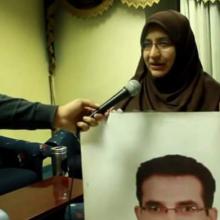
At its 117th session, held in Geneva from 17 October 2016 to 4 November 2016, the United Nations Human Rights Committee (HR Committee) issued its decision on the case of Mohammed Belamrania in response to the complaint filed on 9 May 2012 by Alkarama on behalf of the victim’s son, Rafik. Mohammed Belamrania, a father of ten, disappeared on 13 July 1995 after being arrested by soldiers at his home in the Wilaya of Jijel.

Letter to Member States of the UN Human Rights Council

Re: Support consensus renewal of the mandate of Special Rapporteur on human rights defenders

7 March 2017

Your Excellency,

The undersigned 85 civil society organisations, coming from all regions, urge your delegation to support the renewal of the mandate of the UN Special Rapporteur on the situation of human rights defenders.

On 22 February 2017, Saleh Al Mashhadani, a 22-year-old farmer suffering from hepatitis, disappeared after his arrest by a security forces patrol while working at Salam Al Hashimi’s farms. Al Hashimi is the founder and director of Al Wissam Humanitarian Assembly, a NGO that documents cases of enforced disappearances in Iraq. We fear that Al Mashhadani was arrested because he was working on Al Hashimi’s farm, as a form of reprisals against the latter.

On 27 February 2017, Alkarama sent an urgent appeal to the United Nations Human Rights Committee (HRC) following the arrest of Mr. Rafik Belamrania, the son of Mohammed Belamrania. The latter was arrested in 1995, tortured and summarily executed by the Algerian army.

On 14 February 2017, on the sixth anniversary of the 2011 popular uprising in Bahrain, a number of protests were held all over the country including in the village of Samaheej, north eastern Bahrain, where mass arrests were conducted by the riot police. Among those arrested was 16-year-old Abbas Aoun Faraj, commonly known as Abbas Aoun, who had not taken part in the protests and who was a few meters from his house when the riot police violently apprehended him.

On 12 April 2014, Jaber Al Amri was arrested by officers of Al Mabahith in both uniform and civilian clothing who did not present him with a warrant. After being detained for three months incommunicado and having been deprived of his fundamental rights for a year, Jaber Al Amri was sentenced in May 2015 to seven years in prison followed by a seven-year travel ban and a fine of 50000 Riyals for posting a video on Youtube in which he calls for the release of his brother from prison.

In February 2017, the Subcommittee on Accreditation (SCA) of the Global Alliance of National Human Rights Institutions published its report following its November 2016 session, during which the National Commission on Human Rights (CNDH) was examined, and decided to postpone the review of the CNDH to its Autumn 2017 session.

(14 February 2017) Dr. Mudawi Ibrahim Adam, a prominent Sudanese human rights defender, has been unlawfully detained for over two months, held by the National Intelligence and Security Services (NISS) at Khartoum’s Kober Prison without charge or access to legal representation, 39 human rights groups and activists said.

Bahraini authorities have reached a new low in the arrest and torture of a young man suffering from intellectual disabilities. On 13 December 2016, 18-year-old Kumail Hamida was arrested from his home in the village of Al Sanabis at 4:30 am by masked men in civilian clothing, held incommunicado for three days and subjected to torture to force him to confess to the charges of “participating in demonstrations” and “filming protests”. Kumail was also forced to sign written statements despite the fact that he is unable to read or write.

During its last session held in November 2016, the Sub-Committee on Accreditation (SCA) of the Global Alliance of National Human Rights Institutions (GANHRI) reaccredited the Jordanian National Centre for Human Rights (JNCHR) – the country’s National Human Rights Institu