
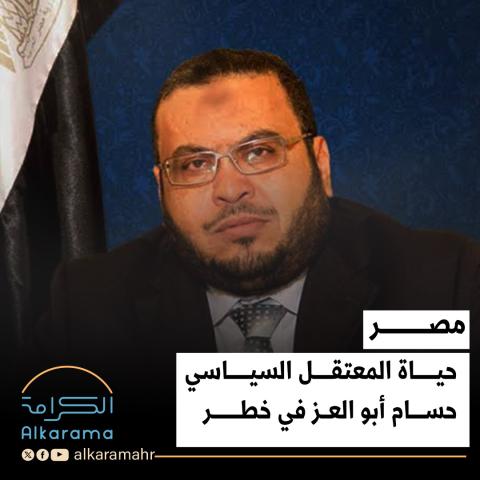
The family of Dr. Hossam Abouelezz, former governor of Egypt’s Qalyubia province, has warned that the political detainee’s life is at risk after receiving reports of several prisoner deaths attributed to medical neglect and inhumane detention conditions.
In a statement to Alkarama, the family said it has had no news of the former governor, who remains deprived of visits and stripped of all his rights.
Human rights sources confirmed the death of detainee “Sameh Amer,” a teacher in his fifties from the village of Samannud in the Ashmoun district of Menofiya governorate. He suffered from heart valve disorders, and his condition severely worsened amid ongoing medical negligence affecting detainees at Badr 3 prison.
Following Amer’s death, prisoners protested by banging on their cell doors and chanting slogans. Some declared they would begin a hunger strike to protest the continued policy of medical neglect inside the prison, which has already resulted in several deaths.
Background of the case
On 19 September 2024, Alkarama filed a complaint with the United Nations Working Group on Arbitrary Detention on behalf of Dr. Hossam Abouelezz, who has been arbitrarily detained since September 2013. The complaint underscores the prolonged and arbitrary nature of his detention, as well as the serious human rights violations he has suffered, including enforced disappearance, extended solitary confinement, and denial of any contact with his family and legal counsel. These long-standing conditions amount to torture and have caused significant physical and psychological harm to Dr. Abouelezz and his family.
This action followed an urgent appeal submitted on 16 February 2022 to the UN Special Rapporteur on Torture. That earlier communication detailed grave violations of Dr. Abouelezz’s rights, including incommunicado detention, enforced disappearance, denial of legal representation, and the refusal of necessary medical care, highlighting the severe impact of these conditions on both him and his family, to a degree that may constitute torture.
Arbitrary detention and unfair trials
Dr. Abouelezz, a distinguished university professor of engineering, was appointed governor of Qalyubia after the election of Mohamed Morsi. However, following the military coup that ousted Morsi and brought Abdel Fattah al-Sisi to power, he was removed from office.
On 17 September 2013, while traveling by car with a friend, he was stopped at a police checkpoint in Cairo. After checking his identity, security forces took him to an undisclosed location without providing any explanation or presenting an arrest warrant.
For two months, his family had no information about his whereabouts or fate, as he was subjected to enforced disappearance. They later discovered that he was being held in Tora high-security prison and that he had been charged during a closed hearing, without legal counsel, with several offenses, including “premeditated murder,” “participation in premeditated murder,” “incitement to premeditated murder,” and “possession and seizure of weapons.” These charges were part of one of the mass trials launched in the aftermath of the violent crackdown on peaceful protesters during the Rabaa sit-in.
In 2015, Dr. Hossam Abouelezz was sentenced to death in the controversial case known as the “Rabaa Operations Room.” The case sought to assign collective responsibility for the deaths and injuries that occurred during the violent dispersal of the sit-in to numerous leaders, former state officials, as well as activists, journalists, and peaceful demonstrators. The proceedings were widely criticized for serious violations of due process and the sweeping nature of the collective charges.
Although the initial death sentence was overturned on appeal, a retrial in 2017 resulted in a life imprisonment sentence, with the charges reduced to “participation in assault resulting in death.” This allegation, unsupported by clear evidence of his individual responsibility, reflects the political character of the case against him.
Inhumane detention conditions and enforced disappearance
In the years that followed, Dr. Hossam Abouelezz was kept in solitary confinement under extremely harsh conditions, first in Al-Aqrab prison and later in Badr 3 prison. Throughout this period, authorities transferred him secretly between various detention facilities without any official acknowledgment or notification to his family. Each transfer was carried out in complete secrecy, leaving his relatives in prolonged uncertainty regarding his fate and location. Only through indirect channels—such as other detainees or their lawyers—was the family able to learn of his whereabouts, often well after the transfers had taken place. The authorities never communicated directly with them, thereby intensifying their psychological suffering.
Unofficial information received by the family indicates that he was held in cells lacking natural light and proper ventilation. Despite suffering from serious chronic illnesses, including diabetes, heart disease, and high blood pressure, he was consistently denied adequate medical care. His family, entirely cut off from contact with him, has received no official updates about his health or detention conditions. This prolonged lack of communication has deepened their anxiety and heightened fears for his safety.
Over the years, the Egyptian authorities have repeatedly refused all requests for family visits, legal representation, or even basic communication, leaving Dr. Abouelezz in complete isolation.
Alkarama maintains that his prolonged solitary confinement and the authorities’ continued refusal to disclose official information about his place of detention amount to a sustained enforced disappearance, recognized under international law as a grave form of torture, not only against the detainee but also against his family.
His family continues to endure severe psychological distress, uncertain whether he is still alive. The absence of medical treatment for his chronic illnesses further increases fears that his life is in serious danger—a situation reminiscent of the death of former President Mohamed Morsi under similar detention conditions.
Alkarama’s requests to United Nations experts
In its complaint, Alkarama states that Dr. Abouelezz has been arbitrarily and unlawfully deprived of his liberty, subjected to inhumane treatment, and denied his fundamental rights under international law. It therefore requested that the Working Group on Arbitrary Detention recognize the arbitrary nature of his detention and call for his immediate release, along with the granting of an enforceable right to reparation.
Given the severity of his detention conditions, Alkarama also urged the Working Group to issue an urgent appeal for his release, stressing that the prolonged solitary confinement, denial of family contact, and his enforced disappearance in recent years amount to torture, both against him and his loved ones.
Alkarama reaffirms its commitment to continue its efforts to secure justice for victims of arbitrary detention in Egypt and to obtain material and moral compensation for the physical and psychological harm and injustice suffered by Dr. Abouelezz and his family.