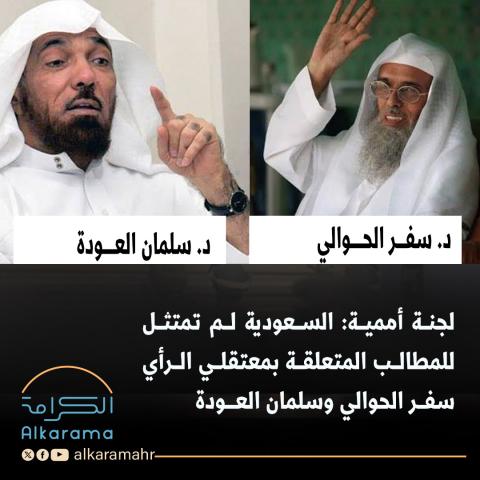
The United Nations Committee on the Rights of Persons with Disabilities (CRPD) found that the Kingdom of Saudi Arabia has failed to comply with its decisions concerning the two intellectuals, Safar Al Hawali and Salman Al Awdah.
The Committee decided to end its follow-up role in this case, while maintaining its requests, due to Saudi Arabia’s failure to meet its obligations under international law and its lack of good-faith cooperation with the Committee’s demands, as well as with other UN human rights mechanisms.
This decision is based on the information and clarifications provided by Alkarama in response to the Saudi authorities’ position, which contests the Committee’s competence and continues to deny the documented violations against Safar Al Hawali and Salman Al Awdah, including prolonged arbitrary detention, solitary confinement, the absence of fair trial guarantees, and restrictions on freedom of expression.
Rachid Mesli, lawyer and director of Alkarama, stated that “there is a clear contradiction between the State’s international commitments and its domestic practices, as well as an expansion in the use of anti-terrorism laws that may undermine freedom of expression and fair trial guarantees.” He also added that “the Saudi authorities have failed to provide the necessary protection for persons with disabilities within the criminal justice system.”
Dr Safar Al Hawali
On 12 October 2020, Alkarama submitted a complaint to the CRPD on behalf of the elderly scholar Safar bin Abdulrahman Al Hawali, who has been arbitrarily detained since 12 July 2018 following the publication of a book in which he criticized the international policy directions of Crown Prince Mohammed bin Salman and put forward recommendations.
In this complaint, Alkarama emphasized that Mr. Al Hawali’s life was under serious and imminent threat, with potentially irreversible consequences. Given this arbitrary detention, Alkarama called on the Committee to intervene to secure his immediate release. In response, on 6 November 2020, the Committee considered that the Saudi authorities should take urgent steps to prevent any harm or risk to Mr. Al Hawali, including his immediate release.
In December 2022, the Committee reiterated its call, urging the Saudi authorities to release Al Hawali without delay. Saudi security forces also arrested his four sons as well as his brother, in what appears to be an act of reprisal and further intimidation.
Since his arrest, Al Hawali has been denied appropriate medical care despite his difficulty speaking and his fragile health condition, and he has been cut off from the outside world.
Subsequently, the United Nations Working Group on Arbitrary Detention (WGAD) examined his case following a complaint filed by Alkarama. In its Opinion No. 26/2023, the experts concluded that his arrest, as well as that of his family members, amounted to retaliation linked to the publication of his book. They expressed serious concern over his detention without trial, as well as the lack of access to medical care and adequate conditions as a person with a disability.
The Saudi authorities arrested Safar Al Hawali, along with his sons Abdullah, Abdelrahman, Ibrahim and Abdelrahim, and his brother Saadallah, between 11 and 13 July 2018.
These arrests are part of a broad and unprecedented crackdown on freedom of expression that began in September 2017. Since then, hundreds of public figures have been targeted, including scholars, academics, and human rights activists, many of whom have been detained solely for expressing criticism of the authorities.
The Working Group also called on the government to ensure that Mr. Al Hawali’s relatives are not subjected to any reprisals in connection with his activities or the exercise of their rights. The experts expressed concern that the Saudi authorities did not dispute the facts presented by Alkarama regarding harassment and reprisals against the Al Hawali family, particularly the documented arrests of family members as a form of punishment linked to his activities.
Dr Salman Al Awdah
Regarding the Saudi thinker Dr Salman Al Awdah, Alkarama also referred the case to the CRPD, which reviewed the matter and contacted the Saudi authorities, asking them to take urgent measures in light of his health condition and advanced age.
The Saudi authorities arrested Salman Al Awdah on 10 September 2017 following a tweet expressing hope for reconciliation in the Gulf region, as part of a campaign targeting several religious figures, preachers, and activists.
Following complaints submitted by Alkarama, the WGAD, during its 97th session, issued Opinion No. 56/2023 concluding that the restriction of Al Awdah’s liberty amounted to arbitrary detention in violation of the Universal Declaration of Human Rights. It noted that the detention was carried out without a judicial order, without access to a lawyer, and without being brought before a judge within a reasonable time, which constitutes a violation of Articles 9, 10, and 19 of the International Covenant on Civil and Political Rights, as well as a breach of fair trial principles. The Group also found that the detention was motivated purely by political reasons and called for his immediate release and appropriate compensation.
Commitments of Saudi Arabia
In light of the ongoing violations targeting Safar Al Hawali and Salman Al Awdah, Alkarama once again urges the Saudi authorities to implement the decisions of the Committee on the Rights of Persons with Disabilities and the United Nations Working Group on Arbitrary Detention, as well as those of other relevant UN mechanisms, and to release them immediately and unconditionally.
Alkarama also calls for an investigation into the circumstances of their arrest and the violations that accompanied it, the end of all politically motivated prosecutions against activists, human rights defenders, and religious figures. Alkarama further calls for the Kingdom to comply with its international obligations under the International Covenant on Civil and Political Rights, the Convention against Torture, and other international human rights instruments.