
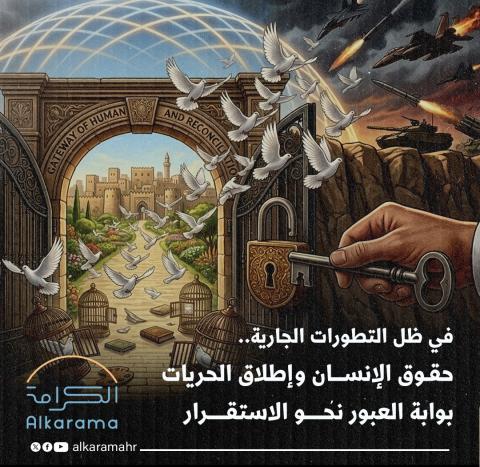
For several days now, the Arab region has been experiencing rapidly unfolding military developments following attacks carried out by the United States and Israel against Iran, which were followed by Iranian strikes targeting U.S. facilities in Gulf countries. These developments have expanded the scope of the conflict and increased the risks threatening regional security and stability, with political, economic, and humanitarian consequences affecting peoples across the entire region.
These events are unfolding at a time when the images of the particularly horrific war of extermination carried out by Israel against the Gaza Strip remain vivid in public memory, with military operations that have also extended into Lebanon. These actions have resulted in a significant number of civilian casualties and widespread destruction of civilian infrastructure, including hospitals, shelters, and vital facilities, along with the imposition of a total blockade and the systematic destruction of the means of survival. Such practices constitute clear violations of international humanitarian law and international law, and are occurring in a context of silence, and even political and military support and complicity from major international powers. This situation undermines the international justice system and reinforces double standards in the application of international law.
In this context, Alkarama stresses that relying on foreign protection or placing trust in external military alliances as a permanent guarantee of security and stability remains a risky wager. Experiences in the region have frequently demonstrated that this approach is ultimately a losing bet that fails to ensure lasting security. Genuine state security derives less from external power arrangements than from strong internal legitimacy grounded in respect for human rights, the rule of law, and the establishment of mutual trust between the state and its citizens.
The Director of Alkarama, lawyer Rachid Mesli, stated: “Peoples who feel that their dignity is respected and their rights protected are the only ones capable of defending their countries and mobilizing to safeguard them in the face of external challenges.” He continued: “Strengthening public freedoms, releasing prisoners of opinion, and opening the public sphere to political participation are essential steps toward consolidating this national contract, which represents the true guarantee of security and stability in the region.”
“The strengthening of security and stability cannot be achieved through purely military or security-based approaches, but requires addressing the deep-rooted political crises and human rights issues affecting the region, foremost among them respect for human rights and the protection of fundamental freedoms,” Me Mesli also stressed before adding: “International experience has shown that lasting stability is closely linked to the rule of law and respect for civil and political rights, including freedom of expression, freedom of association, and the right to participate in political life. The continuation of policies based on repression and restrictions on freedoms only deepens the trust gap between governments and societies and weakens the capacity of states to respond to external challenges.”
In this context, Alkarama recalls the urgent need to end practices of arbitrary arrest and the prosecution of human rights defenders and peaceful activists in Arab countries, particularly in Saudi Arabia and the United Arab Emirates, where many activists, academics, and rights defenders remain imprisoned and face harsh sentences for peacefully exercising their right to freedom of expression and opinion.
United Nations mechanisms, following complaints submitted by Alkarama, have concluded that detention in several cases involving peaceful activists in Saudi Arabia and the United Arab Emirates constitutes arbitrary detention, as part of a broader pattern of using counterterrorism legislation to criminalize the peaceful expression of opinions.
On this basis, Alkarama calls on Arab governments—particularly those of Saudi Arabia, the United Arab Emirates, Egypt, Iraq, and Algeria—to take concrete measures to rebuild trust with their peoples at this sensitive moment in the region’s history. Chief among these measures is the immediate and unconditional release of all prisoners of opinion, human rights defenders, and political opponents detained for peacefully exercising their fundamental rights.
It also calls for an end to practices related to arbitrary detention and unfair trials, for a review of counterterrorism and national security legislation to ensure that it is not used to restrict public freedoms, and for the opening of the public sphere to political participation and the peaceful expression of opinions.
Alkarama considers that the release of prisoners of opinion could represent an important symbolic step toward genuine reconciliation between the state and society, while also contributing to strengthening national unity in the face of growing regional risks. The current period facing the region requires strengthening the internal cohesion of states by expanding political participation and consolidating the rule of law, rather than restricting the space of civil society or silencing critical voices.
Alkarama also emphasizes that the fight against terrorism or responses to security challenges must not serve as a pretext for violating fundamental rights, as international human rights law places a clear obligation on states to protect these rights even in times of emergency. Finally, building a strong internal front based on trust between the state and society remains an essential condition for protecting Arab states from the repercussions of escalating regional conflicts.
From this perspective, Alkarama reaffirms that human dignity in the Arab world, as well as fundamental rights and freedoms, are not a political luxury, but rather an essential condition for ensuring the survival of states and safeguarding stability, security, and peace in the region.