
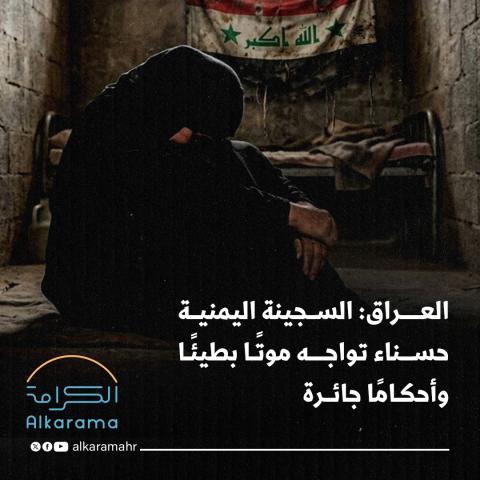
In Iraq, the Yemeni detainee Hasna Ali Yahya Hussayn suffers from chronic illnesses and endures extremely harsh detention conditions, according to human rights sources cited by Alkarama.
She is held in the infectious diseases ward of Al-Rusafa prison in Baghdad, although she does not suffer from such illnesses, but rather from health problems related to the length of her detention and its conditions. She is serving a 33-year sentence based on unjust rulings resulting from proceedings that fail to meet the minimum guarantees of a fair trial, including a decision issued on June 23, 2011, following a hearing that lasted less than ten minutes, without her being able to defend herself.
On May 25, 2011, Alkarama submitted a complaint to the United Nations Working Group on Arbitrary Detention (WGAD), requesting that it intervene with the Iraqi authorities to secure the release of Hasna Ali Yahya Hussayn and appropriate compensation. In its complaint, Alkarama argued that Hasnaa had been arbitrarily detained without legal basis, solely for failing to report her husband, whom Iraqi authorities accused of belonging to an armed group opposed to the American occupation, before he was killed by U.S. forces. Her young children, who were later released, had also been arrested with her, in clear violation of international standards, particularly the International Covenant on Civil and Political Rights (ICCPR), to which Iraq is a party.
Hasna Ali Hussayn was accused of concealing her Egyptian husband, “Abu Ayyoub,” presented as the leader of what is referred to as “Al-Qaeda in Iraq,” who was killed by U.S. forces on April 16, 2010. She was also prosecuted for allegedly harboring individuals suspected of links to “terrorism.”
She was not able to defend herself before the court. The hearing took place in the absence of her lawyer, who reportedly did not appear due to fears of abduction or arrest. A lawyer from his office was then assigned to represent her.
According to her family, the hearing was conducted under conditions that did not meet the fundamental guarantees of a fair trial. Unknown witnesses were reportedly brought forward and heard against her, while neither Hasnaa nor her lawyer had access to the case file or the opportunity to present a defense. Hasnaa was interrupted after stating: “I am the mother of Mohammed, I have three young children, and I do not know who Abu Ayyoub the Egyptian is,” without being allowed to continue.
Originally from the Amran governorate, north of Sanaa, Hasna married an Egyptian national in 1998 who worked as a teacher in a Yemeni village under the name “Youssef Haddad Labib.” He had traveled ahead of her to the Emirates and then to Iraq, where she joined him in 2002. The couple lived in Al-Karrada and Al-Amiriya, then moved after the occupation of Iraq between Fallujah, Abu Ghraib, and Diyala, before settling with their children in the Al-Tharthar area, in Salah ad-Din governorate, north of Baghdad. In April 2010, U.S. forces carried out an attack on their home, killing the husband, also known as “Abu Hamza al-Muhajir,” and arresting Hasna and her three children before handing them over to the Iraqi authorities.
In an interview with the British newspaper The Guardian after her husband’s death, Hasnaa stated that she had no knowledge of his activities and that she was solely devoted to raising her children and household duties.
Hasna’s case remains one of the most concerning humanitarian situations and continues to draw the attention of numerous human rights organizations, both local and international. Her family continues to rely on the diplomatic efforts of the Yemeni authorities to secure her return to Yemen.
The Iraqi authorities agreed to the return of her three children to Yemen, which took place on the evening of Friday, May 14, 2011, while their mother remains in detention and continues to suffer.
For its part, Alkarama will continue to monitor developments in this case and bring it to the attention of United Nations human rights mechanisms.