
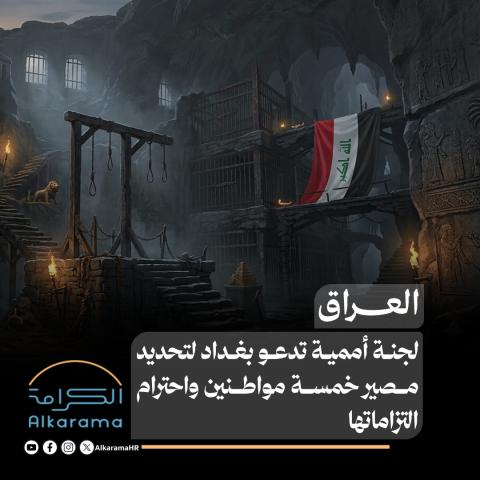
The UN Committee on Enforced Disappearances (CED) has once again called on Iraq to clarify the fate and whereabouts of several victims of enforced disappearance whose cases were submitted to the Committee by Alkarama.
Alkarama has followed the Committee’s latest correspondence concerning five documented cases of enforced disappearance in Iraq. The outcomes vary: four cases remain under review, with the Committee requesting specific information from the State, while a fifth case has been closed in light of new information.
As a State party to the International Convention for the Protection of All Persons from Enforced Disappearance, Iraq is required to conduct prompt and impartial investigations into every allegation of enforced disappearance and to guarantee victims and their relatives the right to know the truth about the fate of their disappeared family members. No exceptional circumstances—whether war or instability—may be invoked to justify such violations. The Committee also stressed that merely confirming that a disappeared person’s name does not appear in the records of the forensic institute cannot replace the obligation to carry out genuine search efforts and thorough investigations until the person’s fate has been conclusively established.
The cases under review
Among the cases examined is that of Mr. Walid Al Janabi, who was arrested in June 2015 by members of the Iraqi army after they raided his family home and took him, together with his two brothers, Khalid and Hamid, to an unknown location. The authorities claimed that an arrest warrant had subsequently been issued against him under the anti-terrorism law. However, the Committee noted that the authorities had failed to explain the inconsistencies surrounding the case and decided to keep it under review.
In a similar case, cousins Duraid and Sattar Al Janabi were arrested at the home of one of them in the Al-Saydiya district by around ten soldiers in the presence of eyewitnesses. Twelve years later, their fate remains unknown. The Committee found that the authorities’ decision to merely show their relatives photographs of unidentified bodies, without conducting a genuine investigation, falls short of their obligations.
With regard to Mr. Ali Al-Sharifi, the Committee decided to close the case after determining that he himself had not been subjected to enforced disappearance and that the person who had in fact disappeared was his brother, Hussein. Nevertheless, the Committee criticised the State for waiting five years before providing this information and for failing to conduct any serious investigation into Ali Al-Sharifi’s disappearance, while reserving the right to reopen the case if necessary.
Regarding Mr. Amer Al-Tikriti, three men wearing military uniforms entered his home in Baghdad in 2014 without an arrest warrant and took him to an unknown location. The authorities merely stated that no arrest warrant had been issued against him and that his name did not appear on any wanted lists, without carrying out any effective investigation. The Committee therefore reiterated its request for a comprehensive investigation, including the questioning of the two witnesses to the arrest.
As for Mr. Hicham Al-Massari, the authorities stated in 2020 that he was being held in Al-Rusafa Prison in connection with terrorism-related charges, before later claiming that there was no record of him in any of their databases. The Committee requested clarification of this clear contradiction and called for an investigation into documented information indicating that a military patrol and an armed militia raided his aunt’s home in 2014 and arrested him. According to the same information, individuals claiming to belong to the Popular Mobilization Forces (Hashd al-Shaabi) later demanded a ransom from his family in exchange for his release, which never took place.
Conclusions and recommendations
Alkarama emphasises that these five cases reveal a recurring pattern: arrests carried out by regular security forces or State-affiliated militias, contradictory or concealed official information, the absence of serious investigations, and the denial of families’ right to know the fate of their loved ones. These practices constitute serious and ongoing violations of Iraq’s obligations under the International Convention for the Protection of All Persons from Enforced Disappearance.
Alkarama calls on the Iraqi authorities to fully implement the Committee’s recommendations and to adopt a comprehensive national strategy for searching for disappeared persons based on genuine, independent criminal investigations, rather than relying solely on checks of forensic databases. It also urges the authorities to ensure that victims’ relatives and their lawyers are able to follow the progress of search efforts and investigations on a regular basis.
Finally, Alkarama calls for all places of detention, both official and unofficial—including those under the control of armed factions affiliated with the Popular Mobilization Forces (Hashd al-Shaabi)—to be opened to independent monitoring mechanisms. It further urges the authorities to ensure that those responsible for enforced disappearances are not granted impunity, regardless of their affiliation, while reaffirming that the right of access to justice must be guaranteed to all without exception.