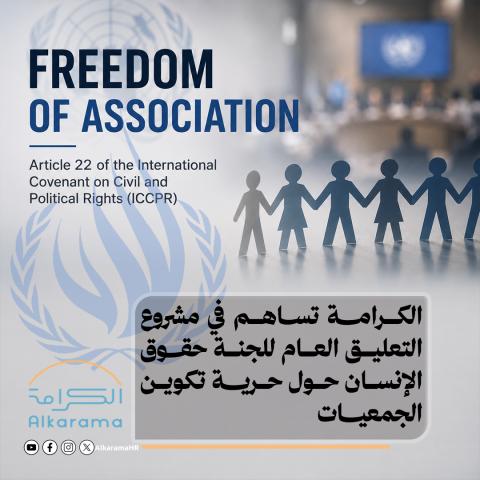
On 15 July 2026, Alkarama submitted a contribution to the United Nations Human Rights Committee (CCPR) as part of the drafting of its General Comment on Article 22 of the International Covenant on Civil and Political Rights (ICCPR), which protects the right to freedom of association.
Through this General Comment, the Committee seeks to clarify the scope of States' obligations under Article 22 and to provide guidance on its interpretation and implementation. As part of this consultation process, it invited civil society organisations and other stakeholders to share their expertise and recommendations.
Drawing on more than twenty years of documenting human rights violations across the Arab world and its extensive experience engaging with United Nations mechanisms, Alkarama submitted a contribution highlighting the recurring practices that undermine freedom of association throughout the MENA region.
Based on documented cases from several Arab countries, the submission highlights, in particular, the criminalisation of independent organisations, the abusive use of national security and counter-terrorism legislation to suppress peaceful associative activities, restrictions on civil society funding, and reprisals against individuals and organisations cooperating with United Nations mechanisms. It draws, in particular, on the prosecutions brought against members of the Saudi Civil and Political Rights Association (ACPRA), the "UAE94" case in the United Arab Emirates, and the repression of the Hirak movement in Algeria.
The submission also addresses the reprisals suffered by Alkarama itself, including the rejection of its application for consultative status with ECOSOC despite a favourable recommendation by the Committee on NGOs, as well as the arbitrary closure of its bank accounts in Switzerland—two situations illustrating the obstacles that human rights organisations may face.
Through this contribution, Alkarama calls on the Committee to clarify that the protection afforded by Article 22 also extends to informal and decentralised forms of collective organisation; that independent organisations must not be criminalised because of their peaceful activities or their lack of formal registration; that national security and counter-terrorism grounds must not be invoked abusively to restrict freedom of association; and that organisations must be able to access funding and cooperate freely with international human rights protection mechanisms without fear of reprisals.
Through this contribution, Alkarama reaffirms its commitment to placing its expertise at the service of the work of the United Nations treaty bodies, with a view to contributing to the development of international human rights law and to strengthening the protection of civil society and human rights defenders throughout the Arab world.