
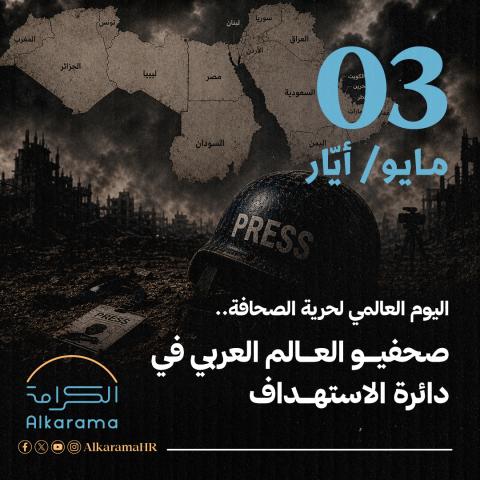
On World Press Freedom Day, observed on May 3, the outlook in the Arab world remains troubling, with a clear decline in media freedoms. Journalists are facing mounting restrictions, while legal frameworks and security tools are being used to silence independent voices. Freedom of expression, however, is a fundamental right protected under Article 19 of the Universal Declaration of Human Rights and the International Covenant on Civil and Political Rights. Despite these guarantees, systematic violations continue across several countries in the region, particularly in conflict zones.
The situation of Palestinian journalists, especially in the Gaza Strip, highlights these concerns in a particularly alarming way. Since the latest Israeli offensive, dozens of journalists have been killed or injured while carrying out their work, often in circumstances suggesting direct or disproportionate targeting, despite their clearly identifiable civilian status. Media outlets have also been struck, with their premises bombed or destroyed, in clear violation of international humanitarian law, which is intended to protect civilians, including journalists.
Beyond physical attacks, journalists are also subjected to other forms of pressure, including threats, legal action, and disruptions to internet and communication services. These measures contribute to isolating Gaza and limiting the flow of information to the outside world. They point to a broader effort to silence witnesses and prevent independent reporting on violations, undermining the right to information and reinforcing a climate of impunity. In this context, human rights organizations, including Alkarama, have called for independent international investigations, accountability for those responsible, and effective protection for journalists in conflict settings.
Across the Arab world, journalists are exposed to a wide range of violations, including arbitrary detention. Some are held for extended periods without legal grounds, or even despite court orders for their release, as in the case of Yemeni journalist Naseh Shaker, for whom Alkarama and the Observatory for Freedoms have referred the matter to the relevant United Nations mechanisms. According to trade unions and NGOs, authorities affiliated with the Houthis continue to detain eight journalists, some of whom have been forcibly disappeared since 2015. Journalists also face killings, intimidation, enforced disappearances, and torture intended to deter them from carrying out their work.
In Saudi Arabia, journalist and activist Turki Al Jasser was executed after nearly seven years of detention and enforced disappearance, based on charges related to the expression of his views. Alkarama brought this case before the relevant United Nations mechanisms, in particular the Special Rapporteur on extrajudicial, summary or arbitrary executions, calling for condemnation of this serious violation of the right to life.
The pressure does not stop with journalists themselves: their families, in Yemen and elsewhere, are also subjected to harassment and reprisals. In addition, many news websites are blocked, restricting public access to independent sources of information.
Over the past decade, these violations have intensified, with journalists paying a heavy price simply for doing their work, in a context marked by near-total impunity.
These patterns reflect a broader trend in the region: the criminalisation of journalism through vague charges such as “terrorism” or “spreading false information,” legal restrictions that undermine media independence, the use of the judiciary as a tool to punish journalists, and the shrinking of digital space through surveillance and blocking. Together, these developments point to a wider effort to curb freedom of expression and shut down space for public scrutiny and accountability.
Alkarama’s Activities
In this context, Alkarama plays a central role in defending press freedom at the international level. It regularly engages United Nations mechanisms, including the Working Group on Arbitrary Detention, and documents violations against journalists through reports and submissions to the Universal Periodic Review. It also takes part in joint advocacy efforts with other organizations to secure the release of detained journalists and strengthen their protection.
Alkarama consistently emphasizes that press freedom is not only an individual right, but a cornerstone of any democratic society based on the rule of law.
On this occasion, Alkarama reiterates its calls for the immediate and unconditional release of all arbitrarily detained journalists, for effective protection of journalists in armed conflict in line with international humanitarian law, for national legislation to be brought into line with international standards on freedom of expression, and for impunity to be addressed through independent investigations and accountability for perpetrators. It also calls for stronger international engagement to support journalists and independent media.