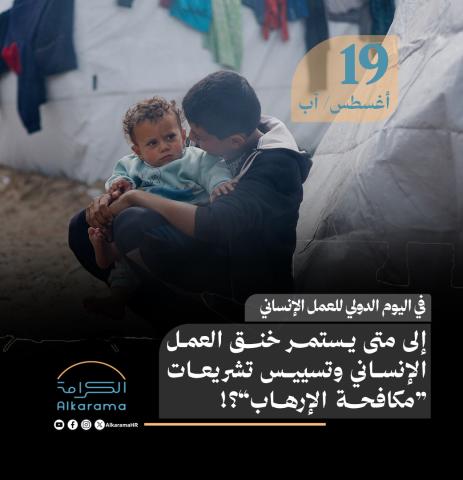
On 19 August, the world marks World Humanitarian Day, established by the United Nations to honour the victims of the 2003 bombing of its headquarters in Baghdad, at a time when humanitarian workers and aid personnel are facing one of the most severe waves of systematic attacks ever recorded in armed conflict, particularly in the occupied Gaza Strip.
Alkarama stresses that humanitarian and charitable action is not a favour granted by States, but an integral part of fundamental rights, including the rights to life, health and an adequate standard of living, enshrined in Articles 22 and 25 of the Universal Declaration of Human Rights, as well as in the International Covenant on Economic, Social and Cultural Rights.
Official data from the United Nations Office for the Coordination of Humanitarian Affairs (OCHA) illustrates the gravity of the situation: more than 560 humanitarian workers have been killed in the Gaza Strip and the West Bank alone over the past three years, out of approximately 1,010 deaths recorded worldwide during the same period. The United Nations Relief and Works Agency for Palestine Refugees in the Near East (UNRWA) has also documented the deaths of 392 of its staff members in Gaza.
Despite the announcement of a ceasefire in October 2025, the Israeli authorities continue to impose severe restrictions on the delivery of aid and access for humanitarian teams, while also targeting duly coordinated convoys. Most recently, the driver of a World Health Organization medical convoy was killed in Khan Younis in April 2026.
These practices cannot be regarded as isolated incidents. They form part of a systematic policy that runs counter to the provisions of the four Geneva Conventions and their Additional Protocols, which prohibit obstructing the impartial delivery of humanitarian assistance and call for urgent international accountability.
Alongside these attacks on the ground, Alkarama has observed since 2004 a growing trend of legislative and administrative restrictions targeting civic and charitable space across the Arab region, whereby counter-terrorism legislation is used to criminalise humanitarian action, including through the freezing of assets and bank accounts on the basis of terrorism lists drawn up according to broad criteria and without minimum guarantees of judicial oversight.
Many governments also prosecute human rights and humanitarian workers for “supporting terrorism” merely for carrying out their activities on the ground, without any criminal intent being established. Humanitarian and human rights organisations are likewise arbitrarily placed on terrorism lists through unilateral decisions lacking judicial basis, as Alkarama itself experienced when it was designated by the United Arab Emirates in 2014.
Alkarama stresses that these practices are expressly incompatible with the United Nations Global Counter-Terrorism Strategy (General Assembly resolution 60/288), as well as with the recommendations contained in reports by the Secretary-General and Special Rapporteurs, which emphasise the need to respect human rights and international humanitarian law and not to invoke counter-terrorism as a pretext for suppressing impartial civil and humanitarian action.
In light of these multiple violations, Alkarama calls for the Israeli occupying power to be required to immediately cease attacks against humanitarian personnel and to open all crossings to humanitarian aid without restriction or condition.
It also calls for Arab legislation on counter-terrorism and its financing to be reviewed, with definitions narrowed to expressly exclude legitimate humanitarian and charitable activities, arbitrary banking restrictions lifted, and secure financial channels provided for humanitarian organisations. Alkarama further calls for decisions to place organisations on terrorism lists to be subject to independent judicial review, guaranteeing the right to challenge such decisions and to an effective remedy.
Alkarama recalls that it works with United Nations mechanisms, particularly Special Rapporteurs, to document the devastating impact of these measures on humanitarian action. It reaffirms its commitment to continuing to monitor and document these violations and to bring them to the attention of the relevant United Nations mechanisms, reaffirming that protecting humanitarian space is the first safeguard for preserving human dignity in times of conflict.