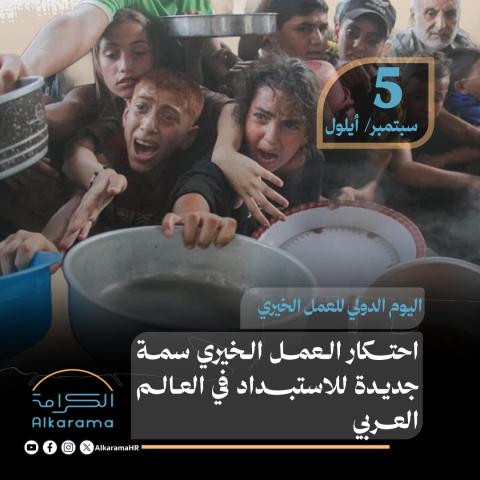
The world marks the International Day of Charity every year on 5 September, proclaimed by the United Nations General Assembly in its Resolution 67/105 of 17 December 2012. This year’s observance comes at a time when restrictions on the charitable and humanitarian space across the Arab world are intensifying, highlighting a stark contrast between the protections afforded by international human rights law to charitable action, as an essential extension of the rights to life, health and an adequate standard of living, and a reality in which regimes restrict this vital sector and subject it to a security-driven approach rather than one grounded in solidarity.
Charitable organisations also play a complementary role to that of public authorities, particularly in times of crisis. When the space for charitable action is restricted, authorities are left unable to provide the assistance needed, as was recently the case during the fires in eastern Algeria.
While charitable organisations, including faith-based organisations, continue to flourish in the West in an environment of relative freedom that enables them to raise billions of dollars in donations each year, many Arab governments continue to restrict charitable action, monopolise the sector and limit it to a small number of entities under their direct control, invoking various justifications.
The monopolisation of charitable action has thus itself become a new feature of authoritarianism in the Arab world. The space for community solidarity, which had long developed independently of the State, has become another instrument of political control, governed by a logic of dependence rather than one of voluntary and free engagement.
The events of 11 September 2001 only served to deepen these restrictions. US security agencies, with the complicity of numerous Arab governments, imposed stringent restrictions on charitable organisations, froze their assets, dismantled their structures and imprisoned dozens of their activists in notorious detention facilities.
Against this backdrop, Alkarama’s archives have documented, since its establishment in 2004, the growing use of “counter-terrorism” legislation as a means of restricting humanitarian and charitable action, including through the freezing of assets on the basis of administrative terrorist lists drawn up according to vague criteria and without even the minimum safeguards of judicial oversight. Alkarama itself experienced this practice when it was placed, in 2014, on an Emirati list of “terrorist” organisations solely on account of its human rights activities.
This trend has not subsided over the past year; on the contrary, it has intensified on several fronts. In occupied Palestine, the Israeli occupation authorities closed the “Al-Tadamoun” charitable association in Nablus in July 2026 and seized its funds, claiming that it had moved beyond its charitable activities to serve as a civilian front supporting activities linked to Hamas. This measure reflects a now familiar pattern of labelling independent humanitarian action in the occupied territories as “terrorist”.
In Yemen, the Houthis have stepped up their campaign against humanitarian and international personnel. Just days after their leader delivered an inflammatory speech targeting aid organisations, forces belonging to the group’s security and intelligence apparatus raided the United Nations residential compound in Sana’a using armoured vehicles and cut off its electricity and communications. Despite international calls to end the prosecution of staff members of international and humanitarian organisations, the group is preparing to refer another group of UN personnel, humanitarian workers and diplomats to a specialised court dealing with “terrorism” cases.
In Tunisia, a human rights report published this year documented an escalation in violations targeting civil society organisations and activists between May 2024 and the end of May 2026, recording 88 cases of restrictions and prosecutions. Another international report documented the prosecution of around 47 civil society actors, at least 14 of whom have been sentenced by the courts, including human rights defender Saadia Mosbah. The activities of at least twenty civil society and charitable organisations have also been suspended.
Against this backdrop, Alkarama reiterates that counter-terrorism must not be used as a pretext to stifle impartial civil and humanitarian action, in line with the United Nations Global Counter-Terrorism Strategy and the recommendations of Special Rapporteurs.
Alkarama calls on Arab governments to review their legislation on counter-terrorism and terrorist financing to expressly exclude legitimate charitable and humanitarian activities, lift arbitrary banking restrictions imposed on associations, establish secure financial channels for humanitarian action, and ensure that decisions to place organisations on terrorist lists are subject to independent judicial review, with guarantees of the right to challenge such decisions and obtain an effective remedy.
Alkarama stresses that Arab and Muslim societies will not achieve sustainable development or genuine well-being unless individual and collective charitable action is freed from the security-driven oversight of regimes. Like all other rights and freedoms, charitable action can only flourish in an environment of freedom, free from the grip of authoritarian rule.