
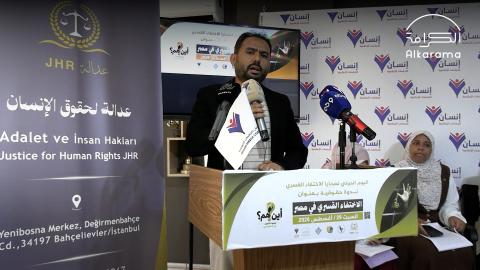
Alkarama had documented hundreds of cases of enforced disappearance and secret detention in Egypt since the July 2013 coup, despite the Egyptian authorities’ continued denial of the existence of such a phenomenon in the country, stated Mohamed Al-Ahmadi, legal researcher and Head of Communications and Media at the organisation.
The statement was made during a seminar organised by the Organisation for Justice and Human Rights in cooperation with the Insan Centre for Media Studies in Istanbul, on the occasion of the International Day of the Victims of Enforced Disappearances. Al-Ahmadi outlined Alkarama’s work over more than two decades to document these violations and bring them before international human rights mechanisms.
Mohamed Al-Ahmadi recalled that the issue of enforced disappearance has been a priority for Alkarama for more than 22 years across several Arab countries. The organisation nevertheless intensified its efforts in relation to Egypt following the July 2013 coup, given the scale of the violations committed in the country, as well as the authorities’ persistent efforts to deny the existence of enforced disappearance and to accuse human rights organisations of making politically motivated allegations.
He explained that Alkarama’s work on cases of enforced disappearance involves several parallel avenues, including the submission of urgent appeals and communications to the Working Group on Enforced or Involuntary Disappearances and, depending on the circumstances of each case, to the Special Rapporteur on extrajudicial, summary or arbitrary executions and the Working Group on Arbitrary Detention.
The organisation has also prepared reports addressing structural issues and pursued avenues for international accountability, including through its contributions to Egypt’s Universal Periodic Review cycles in 2009 and 2014, a report on the persistence of torture six months after the lifting of the state of emergency, as well as a fact-finding report on the events in Port Said in February 2013.
Alkarama also submitted a report to the United Nations Committee against Torture in October 2023, as well as a report to the Sub-Committee on Accreditation of the Global Alliance of National Human Rights Institutions in June 2024, assessing the performance of Egypt’s National Council for Human Rights and its compliance with the Paris Principles.
In its media and documentation work, Mohamed Al-Ahmadi noted that Alkarama continues each year to commemorate the dispersal of the Rabaa al-Adawiya sit-in on 14 August 2013, highlighting the link between the violations committed at the time and the continued impunity for those responsible. The organisation also continues to monitor the human rights situation in Egypt through its periodic reports.
He further referred to Alkarama’s participation in the “Prisoners of Freedom” campaign on the occasion of the 62nd session of the Human Rights Council in June 2026, with the aim of pressing for the release of prisoners of conscience, drawing on Egypt’s membership of the Council until 2028.
Mohamed Al-Ahmadi stressed that the results of human rights work cannot always be measured in terms of immediate or comprehensive victories. He noted that its impact builds over time and that the continued documentation of violations and their submission to international mechanisms can help reduce their prevalence when authorities are aware that they are being monitored and may be held to account.
He stated that several cases followed by Alkarama in cooperation with local organisations had produced tangible results, including cases in which the fate of persons who had disappeared was established, they were officially brought before the prosecution, or they were released. He stressed that moving a victim from a situation of complete disappearance to officially acknowledged detention under a recognised legal framework represents, despite its limitations, a decisive step.
He also indicated that field-based documentation had helped challenge official denials of the existence of enforced disappearance in Egypt, shifting the debate from whether the phenomenon exists to the scale of the practice and the responsibility of those involved. It has also ensured that the issue is repeatedly brought before United Nations human rights mechanisms.
Concluding his intervention, Mohamed Al-Ahmadi stressed the importance of keeping the issue of persons subjected to enforced disappearance in the Arab world on the agenda of United Nations mechanisms. He called on victims’ families not to lose hope and stressed the importance of continuing their legitimate struggle to establish the fate of their loved ones and bring an end to disappearances and concealment in places of detention under the control of the authorities.