
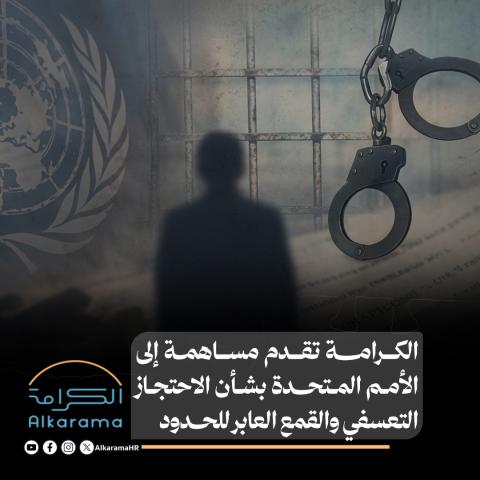
On 1 July 2026, Alkarama submitted a contribution to the United Nations Working Group on Arbitrary Detention (WGAD) as part of its annual thematic report on arbitrary deprivation of liberty in the context of transnational repression.
Based on several years of documenting individual cases submitted to international human rights protection mechanisms, the contribution examines the ways in which certain States seek to repress individuals beyond their borders, including human rights defenders, journalists, whistleblowers and peaceful opponents.
Transnational repression: violations beyond borders
Transnational repression refers to measures taken by a State to silence and intimidate a person located abroad. It can take various forms, including arbitrary arrests, expulsions, forced returns, secret detention, pressure on family members, and the misuse of international cooperation mechanisms.
Drawing on numerous cases documented and submitted to the United Nations Special Procedures, Alkarama’s contribution highlights recurring patterns of violations as well as the risks faced by targeted individuals when they are outside the territory of the State seeking to reach them.
Among the cases examined is that of Mohamed Abdellah, a former Algerian military officer and whistleblower who was forcibly returned from Spain to Algeria in 2021 after exposing corruption within the Algerian military and expressing his views from abroad. Following his forced return, he was held in secret detention, subjected to torture and tried in unfair judicial proceedings.
The contribution also discusses the case of Benhalima Mohamed, another former Algerian military officer who became a whistleblower and was also forcibly returned from Spain to Algeria in 2022 despite concerns about the risks he faced. Following his transfer, he was detained and prosecuted in similarly unfair proceedings.
It also highlights the case of Ayesh Al Harby, whose forced return from Iraq to Saudi Arabia in 2026 illustrates the risks associated with transfers between States when they take place without sufficient judicial safeguards and despite warnings of possible serious human rights violations.
These examples are among the cases included in a broader contribution that highlights the different forms of transnational repression and their impact on the individuals targeted as well as on their families.
It also underlines that these practices may extend to family members, as demonstrated by several opinions of the United Nations Working Group on Arbitrary Detention concerning relatives of human rights defenders or opponents living abroad.
Strengthening international protection against transnational practices
Through this contribution, Alkarama calls on the WGAD to deepen its analysis of transnational repression and to clarify States’ obligations when they participate, directly or indirectly, in forced returns, extraditions, arbitrary detention or other forms of persecution targeting individuals located outside their territory.
This initiative aims to strengthen the way these practices are addressed by international human rights protection mechanisms and to contribute to better protection for individuals exposed to forms of repression that extend beyond national borders.