
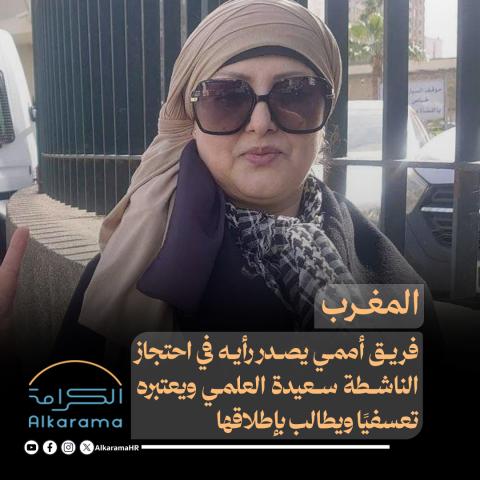
During its 105th session on 24 March 2026, the United Nations Working Group on Arbitrary Detention (WGAD) adopted Opinion No. 8/2026, finding that the detention of Moroccan activist Saida El Alami is arbitrary.
The opinion follows a petition submitted by Alkarama on 16 October 2025 on behalf of Ms. El Alami’s family.
Background
A blogger and human rights defender known for her outspoken criticism of the authorities, Saida El Alami was seized by plainclothes police officers in Casablanca on 1 July 2025 shortly after broadcasting live on social media a demonstration protesting the death of a detainee.
Denied access to legal counsel during her initial questioning, she was subsequently prosecuted over several online posts under provisions relating, among other charges, to insulting a judge, offending a public institution, and spreading false allegations.
On 16 September 2025, she was sentenced to three years’ imprisonment and fined 20,000 dirhams. The conviction and sentence were upheld on appeal on 17 December 2025.
Reprisals in detention
As part of the proceedings before the Working Group initiated following Alkarama’s petition, Ms. El Alami reported that she was subjected to reprisals at Oukacha Prison on 25 December 2025 after being questioned about her engagement with United Nations mechanisms. She stated that she was physically assaulted and humiliated in front of other detainees, while her personal belongings were torn and soaked and she was left without replacement clothing.
These allegations were brought to the Working Group’s attention by Alkarama on 30 December 2025 and were considered during its review of the case.
The Working Group expressed serious concern over these reprisals linked to the use of UN human rights mechanisms, stressing that such acts undermine the rights protected under Articles 9 and 14 of the Covenant and must be investigated promptly and thoroughly.
The WGAD’s findings
In its opinion, the Working Group determined that Ms. El Alami’s detention is arbitrary and incompatible with Morocco’s international human rights obligations. It identified violations of the right to liberty and security of person, the right to a fair trial, and freedom of expression.
The Working Group further noted that the prosecution arose in connection with Ms. El Alami’s human rights advocacy and her critical public statements.
It also recalled Morocco’s obligations under the International Covenant on Civil and Political Rights, including the duty to safeguard fundamental freedoms and refrain from arbitrary detention.
Recommendations to the Moroccan authorities
The Working Group called for Ms. El Alami’s immediate release, the provision of adequate reparation, including compensation, and the opening of an independent investigation into both the circumstances of her detention and the reprisals she allegedly suffered while in custody.
It further requested that the Moroccan authorities report within six months on the measures taken to implement its recommendations.
Alkarama’s follow-up
Following the adoption of the opinion, Alkarama contacted on 19 June both the Permanent Mission of the Kingdom of Morocco to the United Nations in Geneva and the National Human Rights Council (CNDH), urging them to support the implementation of the Working Group’s recommendations.
Alkarama will continue to engage with the relevant authorities and United Nations mechanisms to monitor and promote the effective implementation of the opinion.