
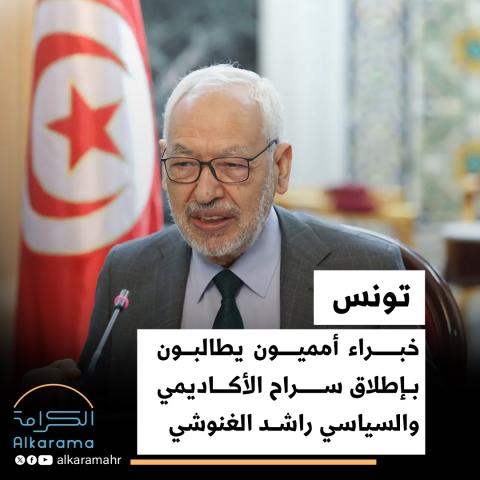
The United Nations Working Group on Arbitrary Detention (WGAD) adopted Opinion No. 63/2025 on 10 November 2025, concluding that the detention of Mr. Rached Kheriji, widely known as “Rached Ghannouchi” and former Speaker of Tunisia’s dissolved Parliament, is arbitrary and calling for his immediate release.
This Opinion follows a joint submission filed on 5 December 2023 by Alkarama and the Association of Victims of Torture in Tunisia (AVTT), which brought to the attention of UN experts the serious violations of Mr. Ghannouchi’s fundamental rights.
Background of the case
Mr. Rached Ghannouchi, aged 84, is the founder and president of the Ennahdha party, the country’s leading opposition movement. He served as Speaker of the Assembly of the Representatives of the People following his election in 2019 and is also recognized as an intellectual and author of numerous academic publications and works.
On 17 April 2023, shortly before the evening breaking of the fast during Ramadan, more than fifty plainclothes security officers entered his home and arrested him violently without a warrant. He was subsequently taken to an undisclosed location and held incommunicado, including being denied access to his lawyer, for 48 hours.
Two days later, on 19 April 2023, Mr. Ghannouchi reappeared at the National Guard barracks in El Aouina. He was then brought before an investigating judge at the Tunis Court of First Instance, where he underwent prolonged questioning regarding public statements in which he criticized the marginalization of opposition parties—whether leftist or affiliated with Ennahdha—and warned of the risk of a “civil war scenario.”
Following more than nine hours of interrogation, the investigating judge ordered his pretrial detention, arguing that his statements amounted to “acts intended to alter the nature of the State, incite citizens to arm themselves against each other, and provoke chaos, killings, and looting across Tunisian territory.” After being accused by state media and supporters of the authorities of inciting “civil war,” Mr. Ghannouchi was placed in Mornaguia prison, where he remains detained.
His arrest occurred in the context of exceptional measures introduced by President Kaïs Saïed starting on 25 July 2021, when he dismissed the Prime Minister, suspended Parliament, lifted parliamentary immunity, and curtailed a number of individual and collective freedoms, in breach of the Constitution. The political climate in Tunisia subsequently deteriorated, with arbitrary arrests, dismissals of government and judicial officials, and a broader repressive approach targeting the opposition as a whole, particularly members of Ennahdha.
Since December 2022, at least 17 current or former party members have been arrested, including Mr. Ghannouchi, who has continued to express his opposition publicly and peacefully to violations of the rule of law and to call for a return to constitutional legitimacy and democratic governance.
Arbitrary detention of a political nature
In its Opinion, the Working Group stresses that Mr. Ghannouchi’s arrest at his home on 17 April 2023 was carried out without a warrant and followed by 48 hours of secret detention, during which neither his family nor his lawyer was informed of his whereabouts. The experts recall that “for a deprivation of liberty to be legally grounded, it is not sufficient that domestic law permits arrest,” and emphasize that judicial oversight is a fundamental safeguard of personal liberty.
They further find that his detention stems from the peaceful exercise of his rights, particularly freedom of expression, and that the conditions of his detention violated his right to a fair trial. He was prevented from preparing his defense, obstructed in accessing legal counsel, and subjected to hearings held in his absence. According to the Working Group, these serious breaches render the deprivation of liberty arbitrary and unlawful.
The Working Group also underlines the political dimension of this detention. It considers that the imprisonment of Mr. Ghannouchi, as leader of the Ennahdha party, is intended to penalize members of political groups and silence their demands. In other words, UN experts conclude that he is being targeted because of his political role and affiliation with Ennahdha, rather than for any legitimate legal grounds.
The experts also stress that Mr. Ghannouchi, who is 84 years old and suffers from Parkinson’s disease, must be treated “with humanity and with respect for the inherent dignity of the human person.”
The Working Group concluded that “the appropriate remedy is the immediate release of Mr. Kheriji (Ghannouchi) and the granting of an enforceable right to compensation” while also calling for an independent investigation into the documented violations.
For its part, Alkarama stated that it will follow up on the implementation of this Opinion, while the Tunisian authorities have a six-month period to report on the concrete measures taken.