
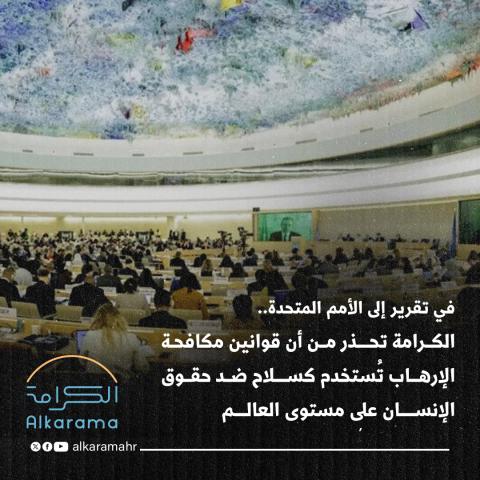
Alkarama Submitted a Report to UN Human Rights Council on Systematic Abuses in Counter-Terrorism Frameworks Across the Arab World and Beyond
Governments globally are systematically exploiting counter-terrorism laws to silence dissent, detain peaceful activists, and facilitate transnational repression, Alkarama said in a report submitted on March 20, 2026, to the United Nations Office of the High Commissioner for Human Rights (OHCHR).
The submission, filed on March 20, 2026, responds to a call for inputs from the OHCHR, in connection with Human Rights Council resolution 57/11 on “Terrorism and Human Rights”. The forthcoming UN report, covering the period July 2024 to June 2026, is scheduled for presentation at the 63rd session of the Human Rights Council, scheduled to run from 7 September to 9 October 2026.
“For over two decades, we have seen counter-terrorism law function not as a shield for populations, but as a sword against them,” said Rachid MESLI, Alkrarama’s Director. “We observe that the single most persistent driver of systematic abuse globally is the adoption of overbroad terrorism definitions that fail every test of legality, necessity, and proportionality under international law. When a government can label peaceful criticism of injustice as 'terrorism,' it is no longer about fighting terror. Rather it is about enforcing control over thoughts and speech.”
Vague Definitions Leading to Systematic Human Rights Abuse
At the core of Alkarama's findings is the widespread use of terrorism definitions so broad and imprecise that they sweep in protected conduct alongside genuine threats. Across numerous jurisdictions in the MENA region and EU member states, laws target acts that “may seriously damage a country's reputation” or “destabilize political, constitutional, economic or social structures”. Such language foreseeably criminalises peaceful protest, journalism, and civil society activity.
Furthermore, the report documents how conflating terrorism with broad and subjective notions such as “extremism”, “subversion”, and “radicalism” creates an additional legal slippery slope, shifting the state’s focus from effectively preventing violence to suppressing non-violent political dissent. Once enshrined in law, these elastic concepts equip governments with sweeping surveillance and administrative powers to police beliefs while effectively blurring the boundary between genuine counter-terrorism and the illegal repression of critical voices.
Administrative Measures Bypassing Judicial Reviews
Of particular concern is the growing use of administrative measures – including entry bans, non-judicial expulsions, and preventive detention – that operate outside independent and effective judicial oversight. These procedures strip individuals of the right to challenge their detention or administrative expulsion before an independent tribunal, to access legal representation, or even benefit from the presumption of innocence.
Alkarama documented concrete instances of this pattern, including, amongst other cases:
- Spain’s administrative removal of whistleblowers and conscientious objectors to Algeria in violation of the principle of non-refoulement.
- France’s imposition of entry bans on Algerian political opponents based on an unlawful Algerian administrative terrorist listing, despite a communication by the Special Rapporteur on human rights and counter-terrorism identifying the listing as a violation of legality and due process; and the use before French administrative tribunals of unsigned, undated intelligence notes provided by third states in reprisals against Algerian human rights defenders and opponents.
- Saudi Arabia and the United Arab Emirates use of “Rehabilitation centres” to keep in indefinite administrative detention peaceful dissenters until they agree to “reform” their thoughts in favour of their respective rulers.
Such measures are based on special counter-terrorism laws which remain in place – and in some cases have even been tightened – notwithstanding country visits reports by UN Special Procedure mandate holders and repeated communications flagging their incompatibility with international law.
International Cooperation Enabling Transnational Repression
Counter-terrorism cooperation between states has become a conduit for the cross-border export of repressive practices, placing dissidents as well as asylum seekers and political opponents in acute danger abroad. Interpol, originally designed to facilitate legitimate law enforcement cooperation, has been used by some governments to pursue political opponents via politically motivated arrest mandates issued under counter-terrorism frameworks.
When Interpol's human rights review mechanisms have blocked such mandates, states have pivoted to bilateral security agreements and diplomatic assurances to achieve the same result - thus circumventing both international oversight and their domestic judicial safeguards.
Most recently, Alkarama documented the case of M. Aish Al-Harbi, a Saudi asylum seeker residing in Iraq who was extradited to Saudi Arabia despite an urgent appeal communication warning of a credible risk of torture and a death sentence. The case illustrates a broader pattern of extraditions and removals conducted in disregard of the absolute prohibition on refoulement, disproportionately affecting individuals with histories of political opposition sought by their home states for purposes of reprisal.
Saudi Arabia: Political Repression of Pilgrims at Islam's Holiest Sites in Breach of Sacred Trust and International Law
In its report, Alkarama raised the alarm over a documented practice by Saudi Arabian authorities of arbitrarily arresting and forcibly disappearing non-Saudi nationals during religious pilgrimage to Mecca. Those targeted are detained based on alleged affiliations with groups considered hostile to Saudi foreign policy, particularly nationals of countries where Saudi Arabia has a direct military or political stake, including Yemen and Libya.
The arrests and detentions of pilgrims occur without charges or procedural safeguards, relying on Saudi Arabia's expansive terrorism definition — one that explicitly encompasses peaceful criticism of the ruler or the country's regional allies. This is particularly concerning given that in 2024, 1.6 million international pilgrims from over 180 countries visited the Kingdom to perform their religious obligations – with no reason to suspect that doing so could expose them to arbitrary arrest – extending Saudi Arabia's repressive reach to nationals from countries across the world.
“Muslims from around the world travel to Mecca to fulfil one of their faith's most sacred obligations, with no thought that doing so could end in their arrest and disappearance," said MESLI, Alkarama’s Director. “Yet Saudi authorities have used the pilgrimage as an opportunity to detain individuals for political opinions held thousands of miles away. No country should be permitted to leverage its custodianship of holy sites to conduct its transnational political repression, in breach of both international law and a centuries-long sacred trust”.
Rights to Life, Liberty, and Security: Torture, Disappearances, and Use of Secret Evidence
Across the Arab world, Alkarama has documented patterns of serious violations of rights to life, liberty, and security in counter-terrorism contexts. These include detention without charges or sufficient legal basis, denial of fundamental due process guarantees, torture, and enforced disappearances, creating conditions of systematic and undetected abuse.
Even in democratic states, governments have relied on unverified intelligence from foreign partners and undisclosed information, rather than clearly defined violent acts, to justify administrative measures ranging from territorial entry bans to criminal convictions. The reliance on secret evidence that defendants cannot access or challenge effectively empties the presumption of innocence of its substance.
Criminalising Dissent: From Crackdowns on Gaza Solidarity Globally to 'Rehabilitation' Centres in the Gulf"
During the reporting period, Alkarama observed a global crackdown on free expression targeting voices denouncing the genocide in Gaza, with counter-terrorism legal frameworks invoked against protesters even in established democracies.
In Saudi Arabia and the United Arab Emirates, so-called “rehabilitation centres” function as institutions of forced thought-reform, holding political detainees beyond the end of already arbitrary sentences until authorities determine they have abandoned non-approved religious or political views. In Saudi Arabia’s case, the official state religious doctrine treats public criticism of the ruler as a religious offence under anti-terrorism law, making dissent simultaneously a political and a theological crime.
Meanwhile, opaque listing processes – designating individuals and organizations as terrorist-linked without judicial review or meaningful opportunity to challenge the evidence, have had severe cascading consequences. Organisations working with Muslim communities have found themselves unable to access basic banking services, forcing some to shut down entirely, including in democratic settings.
Algeria's Citizenship-Stripping Law: One of the World's Harshest New Measures
In one of the most sweeping and legally extreme citizenship-stripping measures adopted anywhere in the region in recent years, Algeria’s parliament voted unanimously in both chambers in December 2025 to introduce a new Article 22 bis to its Nationality Code, published into law in February 2026. The measure stands out even in a region where citizenship deprivation has increasingly been weaponized as a tool of political repression.
The new provisions allow authorities to strip nationality from any national abroad on the basis of “serious and converging indicators” of conduct likely to “harm Algeria's interests, national unity, state security, or the stability of its institutions”. Such language has been lifted directly from the overbroad terrorism definition in the Algerian Penal Code, which UN Special Procedures have already criticized for being vague and unclear allowing for the criminalisation of the legitimate exercise of the freedoms of speech, assembly, association, and participation in public life. New grounds also encompass leading, participating in, financing, or promoting 'terrorist or subversive groups'. Such categories are broad enough to capture virtually any form of organised dissent, and it is left entirely to the government to determine who and what falls within them, without any possibility of prior or subsequent recourse to administrative or judicial remedy.
Most strikingly, the law explicitly excludes any form of legal challenge before administrative or ordinary courts and extends expressly to NGOs receiving foreign funds and documenting human rights violations, effectively making human rights work itself a basis for statelessness. Stripping citizenship without recourse or judicial oversight places Algeria among the most repressive states globally on this measure, and stands as a stark illustration of how counter-terrorism frameworks are deployed to eliminate independent civic space and silence the documentation of abuses.
Systematic Discrimination Against Muslim Communities under Counter-Terrorism and Preventive Frameworks
The report documents persistent patterns of discriminatory application of counter-terrorism laws against Muslim communities in countries where they constitute minorities. Religious motive clauses in terrorism legislation have led courts to put Islamic practice itself on trial, systematically overshadowing the core elements of criminal liability in favour of religious profiling.
The criminalisation of religious observance as a sign of 'radicalism', equated with 'extremism' and therefore falling under terrorism prevention frameworks, constitutes a dangerous conflation of internationally protected religious freedom with criminal behaviour. This discriminatory logic has also begun to extend to other social movements, including environmental activists, demonstrating the breadth of harm caused by overbroad and politically instrumentalised counter-terrorism frameworks.
Recommendations
Based on these findings, Alkarama called on the OHCHR to urge states to implement reforms, including:
- Adopting narrow, rights-compliant definitions of terrorism limited to intentional killing or serious bodily harm combined with the specific intent to terrorise a population or coerce a government.
- Removing references to ideological, political, or religious motives from terrorism definitions, given documented patterns of discriminatory overreliance on such criteria.
- Reviewing and repealing domestic counter-extremism regimes that criminalise beliefs, associations, or non-violent conduct, replacing them with measures targeting only clearly defined violent crimes.
- Incorporating explicit exclusions from terrorism definitions for non-violent expression and association, civil disobedience, trade union activity, humanitarian and human rights work, and ordinary public order offences.
- Establishing binding safeguards against discriminatory application, including explicit prohibitions on profiling based on religion, ethnicity, or political opinion.
- Reforming international cooperation mechanisms to prevent their use for transnational repression, including through independent oversight of bilateral agreements and diplomatic assurances.
- Strengthening the mandate and capacity of the Special Rapporteur on human rights and counter-terrorism to function as an independent international expert review mechanism with the authority to identify effective remedies for violations of international law.
What Comes Next?
Alkarama’s submission will feed directly into the UN High Commissioner for Human Rights' forthcoming report to the Human Rights Council, scheduled for the 63rd session. That report is mandated by Human Rights Council resolution 57/11 to examine both the impact of terrorism on human rights and the human rights violations committed in the name of countering it.
The inputs provided by civil society are expected to form the evidentiary backbone of the High Commissioner's report and will be made available on the OHCHR website. The report will be presented to member states of the Human Rights Council, providing a multilateral forum for scrutiny of state counter-terrorism practices and an opportunity to press for accountability and reform.
Alkarama calls on UN member states, regional bodies, and international partners to engage seriously with the High Commissioner's forthcoming findings and to commit to aligning their counter-terrorism frameworks with the international human rights obligations they have undertaken.
For more information on our work on Counter-terrorism and Human Rights here
For more information you can contact us at info@alkarama.org