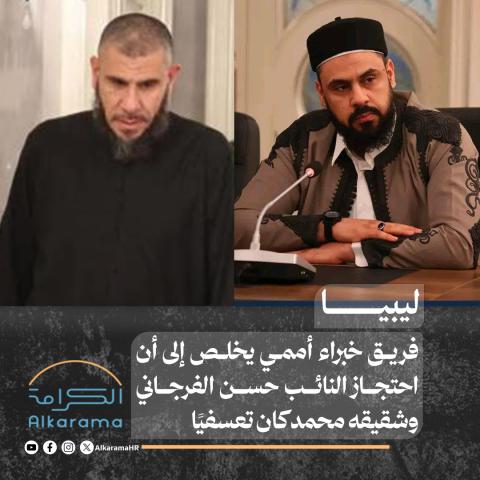
The United Nations Working Group on Arbitrary Detention (WGAD) has adopted Opinion No. 76/2025, finding that the deprivation of liberty of Hassan Elfargani Salem, a member of Libya's House of Representatives, and his brother Mohamed Elfargani Salem was arbitrary under international law.
The Opinion follows a petition submitted by Alkarama after the two brothers were arrested by the Radaa force in 2023. In its submission, Alkarama denounced, in particular, their arrest without a warrant, their incommunicado detention, the obstacles placed in the way of their right to defence, and the other violations of the fundamental guarantees surrounding their deprivation of liberty, requesting the Working Group to determine whether their detention complied with international standards.
Throughout the proceedings, Alkarama continued to monitor the case by keeping the Working Group informed of subsequent developments, including the progress of the proceedings against the two brothers and their eventual release. These exchanges enabled the UN independent experts to consider the most up-to-date information before adopting their Opinion.
In the meantime, Hassan and Mohamed Salem were released under a presidential pardon, a few days after Hassan Salem was acquitted on appeal. While their release marked an important development, Alkarama nevertheless maintained its petition so that the alleged violations could be examined on the merits and formally recognised by the United Nations mechanism.
The Working Group itself decided to continue its consideration of the case despite the brothers' release, finding that the allegations of serious violations—including incommunicado detention, torture and ill-treatment, violations of fair trial guarantees, and reports of continued surveillance following their release—warranted the adoption of an Opinion.
In its Opinion, the Working Group concluded that their detention fell within categories I and III of its mandate. It notably found that there was no legal basis for their arrest, that they were held in detention without effective judicial review, that their access to legal counsel had been restricted, that civilians had been tried before a military court, and that credible allegations of torture and ill-treatment had been raised.
The Working Group called on the Libyan authorities to provide the two brothers with full reparation, including compensation, to conduct an independent investigation into the violations identified, and to take the necessary measures to prevent their recurrence.
This Opinion highlights the importance of engaging international human rights protection mechanisms. Even where victims are released while proceedings are ongoing, pursuing the case makes it possible to secure international recognition of the violations committed, reaffirm the obligations of the State concerned, and safeguard the victims' right to an effective remedy.