
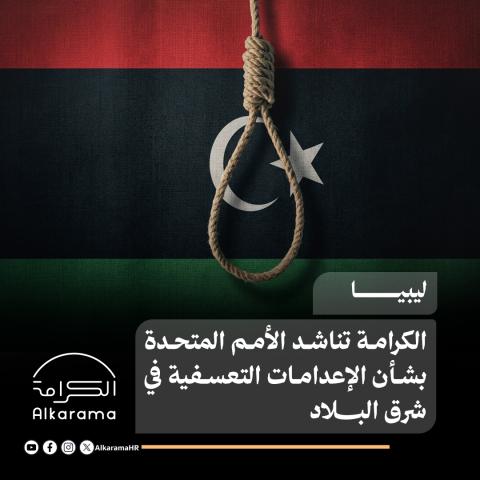
On 7 October 2026, Alkarama submitted an urgent appeal to the United Nations Special Rapporteur on extrajudicial, summary or arbitrary executions, denouncing the gravity of the situation in eastern Libya. Alkarama is drawing the attention of UN human rights protection mechanisms to the growing number of arbitrary executions handed down by exceptional military courts operating under the de facto authority of Khalifa Haftar.
The case of Naseeb Jamal Atiyya The urgent appeal highlights the emblematic case of Mr Naseeb Jamal Atiyya, a 32-year-old native of Derna and student at the Saqr Institute of Business Administration. Arrested on 3 June 2018 after voluntarily presenting himself to the counter-terrorism services (Jahaz Mukafahat al-Irhab), Mr Atiyya was held incommunicado for several months and subjected to serious acts of torture in order to extract confessions from him.
Transferred to Qarnada Prison, he was sentenced to death in July 2019 by a so-called “military court”, following summary and manifestly unfair proceedings during which even a lawyer appointed by his father was denied access to the criminal case file.
On 22 August 2026, his family was informed of his death and summoned to identify his remains. During the identification of the body at the Benghazi morgue, his father observed clear signs of torture and an advanced state of decomposition, suggesting that his death had occurred well before the official announcement of his execution. No official documentation attesting to the lawful conduct of the execution, in accordance with the Libyan Code of Criminal Procedure was drawn up or provided to the family.
Imminent threat of execution facing 23 identified civilians
Mr Atiyya’s death forms part of a new wave of repression that began in late August 2026, during which the United Nations Support Mission in Libya (UNSMIL) has already recorded more than 30 arbitrary executions. Alkarama has documented a list of 23 individuals sentenced to death, currently detained in Qarnada Prison and facing an imminent risk of execution. This list was also transmitted to the UN Special Rapporteur.
Proceedings in violation of international and domestic law
Alkarama recalls that these convictions are based on serious violations of both international and domestic law. Indeed, in its ruling No. 22/71 of 2 November 2025, the Libyan Supreme Court established that the referral of civilians to military courts for terrorism-related or security offences was unconstitutional.
Furthermore, the special counter-terrorism law (Law No. 3 of 2014) abolished the death penalty, yet the courts established by Khalifa Haftar continue, unlawfully, to apply provisions of the former Criminal Code that have been invalidated by the Supreme Court.
It should also be recalled that the exceptional military courts established in the eastern part of the country were set up by a de facto authority that is not recognised by the United Nations.
However, in view of the urgency of the situation and the irreversible nature of these violations of the right to life, Alkarama considered it necessary to bring the matter before the Special Rapporteur on extrajudicial, summary or arbitrary executions and urge him to intervene urgently with the authorities in Benghazi in order to order the immediate cancellation of all scheduled executions and establish an official moratorium on the implementation of the death penalty.
Alkarama firmly reiterates that the right to life admits of no exceptions that recourse to the death penalty contributes neither to justice nor to peace and that its arbitrary application constitutes a flagrant violation of international law and an unacceptable regression in the protection of fundamental freedoms.