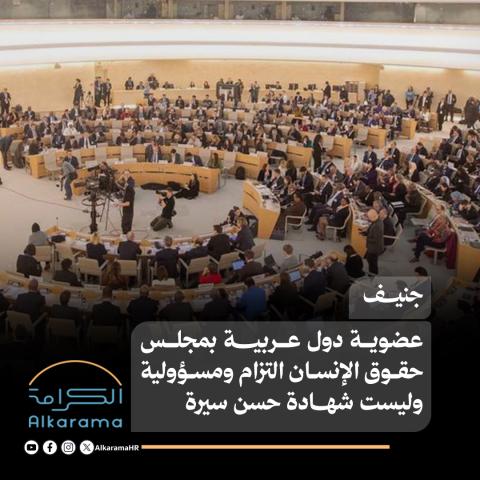
On 13 October 2026, the United Nations General Assembly elected Kuwait and Jordan to the Human Rights Council for the 2027–2029 term, with 173 and 171 votes respectively. Kuwait’s election marks the beginning of a second consecutive term. They will join Egypt and Iraq, whose terms run until 2028, and Qatar, which will remain a member of the Council until 2027.
The presence of these Arab States on the Council carries a collective responsibility to ensure that their membership serves as a catalyst for improving the human rights situation, rather than shielding them from accountability.
Alkarama stresses that membership of the United Nations Human Rights Council is no endorsement of a State’s domestic human rights record or recognition of its compliance with international standards. Rather, it entails a particular responsibility to ensure that national practices match the commitments made on the international stage.
The States concerned must therefore uphold freedom of expression and peaceful assembly, protect journalists and human rights defenders, cooperate fully with the Special Procedures and other United Nations mechanisms, and implement the recommendations made under the Universal Periodic Review (UPR). Yet the record of the Arab States currently serving on the Council reveals no tangible improvement in the field of human rights.
Alkarama will continue its efforts to strengthen the United Nations human rights protection system. In this regard, it will continue to submit individual cases to the Special Procedures and treaty bodies, contribute to the Universal Periodic Review and document human rights violations across the Arab world. It urges the newly elected States to demonstrate a genuine commitment to engaging with these mechanisms by providing substantive responses to communications addressed to them, responding to requests for country visits and implementing recommendations, rather than limiting their engagement to formalities.
Alkarama calls on Arab States serving on the Council to use their mandates to help bring about meaningful improvements in the human rights situation across the region. They should lead by example at home while defending victims’ rights in international forums. The credibility of their membership will ultimately be judged by the reforms they deliver in practice and by their response to victims’ and their families’ demands for freedom, justice and reparation.
The Human Rights Council provides a multilateral forum for addressing human rights violations and examining human rights situations in countries around the world. It also responds to human rights emergencies and issues recommendations aimed at improving the effective enjoyment of human rights on the ground.
One of the Council’s key functions is to conduct the UPR. This is the only United Nations mechanism through which every State, without exception, is subject to a peer review every four and a half years. The process results in public recommendations, which carry a political obligation to be implemented. The UPR also provides civil society organisations and victims with an opportunity to bring their concerns to the attention of the States conducting the review. It therefore offers a framework for assessing governments’ commitments against concrete benchmarks and holding them accountable for their implementation.
In the Arab world, Sudan and Syria are scheduled for review in January 2027, followed by Algeria, Bahrain, Morocco and Tunisia in November of the same year. The United Arab Emirates will undergo its review in May 2028. Alkarama urges these States to approach the process in earnest by holding genuine national consultations with civil society, submitting reports that accurately reflect the human rights situation, accepting substantive recommendations and ensuring their implementation. The UPR must not become a mere procedural exercise that ends with the conclusion of the review session, without any meaningful follow-up.
It should be recalled that membership of the Council is based on equitable geographical distribution, with seats allocated as follows: the African States Group (13 seats), the Asia-Pacific States Group (13 seats), the Eastern European States Group (6 seats), the Latin American and Caribbean States Group (8 seats), and the Western European and Other States Group (7 seats).