
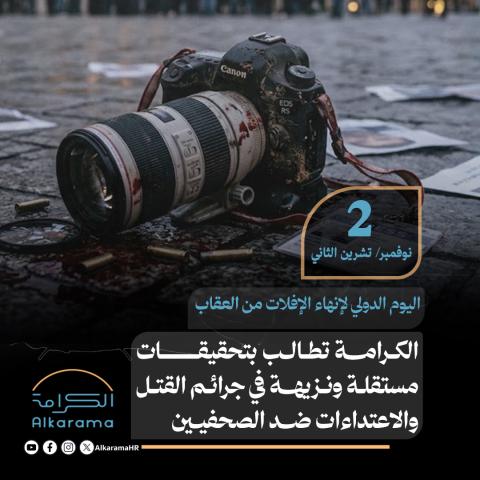
On 2 November, the international community observes the International Day to End Impunity for Crimes against Journalists, established by the United Nations General Assembly in 2013. Ensuring the safety and protection of media professionals has become one of the most pressing human rights challenges worldwide. Bringing an end to impunity for crimes committed against journalists is fundamental not only to upholding freedom of expression, but also to guaranteeing everyone's right to seek and receive information.
This year's theme draws attention to the ways in which emerging technologies and weapons are changing the nature of the threats faced by journalists, particularly in conflict-affected areas, as highlighted by the United Nations. Yet, despite the changing methods used to target them, one reality remains constant: those responsible for killing journalists continue to escape accountability and justice. The consequences of such impunity extend well beyond the victims and their families, affecting society as a whole. When attacks against journalists go unpunished, the public is deprived of independent reporting in the public interest, including investigations that expose corruption, human rights violations and criminal activity.
The global deterioration of press freedom in recent years has been accompanied by a growing range of threats against journalists. Attacks have increased, abusive lawsuits designed to silence critical voices and discourage public participation (SLAPPs) have become more widespread, and arbitrary detention, intimidation and killings have continued unabated. Independent journalism has consequently become an increasingly dangerous profession. The failure to make meaningful progress in tackling impunity is reflected, in particular, in the rising number of journalists killed in conflict zones.
Figures from the UNESCO Observatory of Killed Journalists show that more than 1,600 journalists were killed worldwide between 2006 and 2025, with nearly six out of every seven cases still lacking a judicial resolution. Impunity perpetuates this cycle of violence and is often symptomatic of escalating conflicts and the breakdown of legislative and judicial institutions. UNESCO warns that the absence of accountability has far-reaching consequences for entire communities, allowing serious human rights violations, corruption and criminal activity to remain hidden. Governments, civil society organisations, media outlets and all those committed to strengthening the rule of law must therefore contribute to international efforts to end this phenomenon.
The UNESCO report on the safety of journalists and impunity for the period 2024–2025 documents 97 journalists killed in Arab countries, the highest toll recorded across all regions of the world. Palestine ranks first, with at least 30 journalists killed in 2024 and 32 in 2025. The report further indicates that drones were responsible for the deaths of more than a quarter of the journalists killed during this period. The largest share of these cases occurred in Palestine, where 32 journalists were killed by the Israeli occupation.
For Alkarama, these figures are a stark reflection of the conditions imposed by the Israeli occupation in the occupied Palestinian territory, particularly through its devastating war on the Gaza Strip, where civilian journalists, who enjoy protection under international humanitarian law, have been repeatedly targeted. Since 2006, nearly 100 local journalists have been killed in Palestine. According to the UNESCO report, local journalists account for 91% of those killed in armed conflict zones. This highlights the fact that those risking their lives to report on events are themselves members of the communities and territories they cover. In 2025, the Parliamentary Assembly of the Council of Europe called for journalists in Gaza to be protected and for foreign media to be granted access to the territory, which remains closed to international observers.
Alkarama considers that the repeated targeting of journalists in Palestine, coupled with the absence of independent investigations and prosecutions, engages the responsibility of the Israeli occupying Power under international law for ensuring their protection. It calls for international investigations into the commission of war crimes, the activation of international criminal justice mechanisms and unrestricted access to Gaza for the international press. Targeting those who bear witness does not merely silence individual voices; it also deprives the world of the truth.
The situation is particularly alarming in the Arab region, which, according to the UNESCO report, has the highest impunity rate worldwide, standing at 98%. Of the 496 killings of journalists documented across the region since 2006, only eight cases have been judicially resolved. Even more concerning, not a single new case has been resolved over the past two years.
Alkarama's commitment
Alkarama continues to monitor cases involving journalists and media professionals who have been killed, arbitrarily detained, forcibly disappeared, tortured or subjected to unfair trials across the Arab world. It documents these violations and submits them to the relevant United Nations mechanisms, including the Special Rapporteur on the promotion and protection of the right to freedom of opinion and expression and the Working Group on Arbitrary Detention. The cases, complaints and statements available in the Alkarama website archives reflect this sustained work and serve as a resource for anyone seeking to understand the extent of the violations faced by journalists in the region.
On this occasion, Alkarama calls on the relevant authorities to ensure that all killings and attacks against journalists are investigated through independent, effective and impartial investigations, that those responsible are brought to justice, and that victims and their families receive justice and reparation. It further demands the immediate release of all journalists detained in connection with their professional activities. Alkarama also urges the international community to step up its support for accountability mechanisms. Justice for journalists is not simply a matter of defending a profession; it is essential to upholding the right of entire societies to know the truth.