
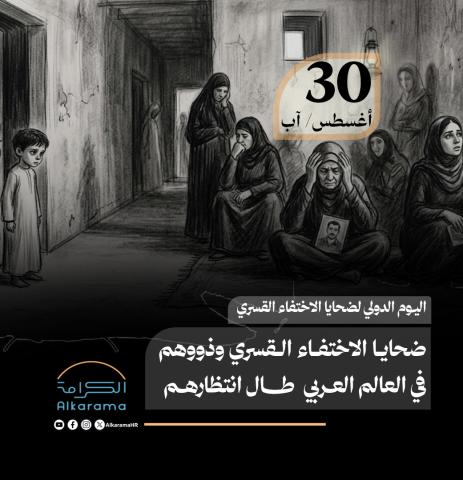
Every year on 30 August, the world marks the International Day of the Victims of Enforced Disappearances, established by the United Nations General Assembly in resolution 65/209 of 21 December 2010, in recognition of the suffering of hundreds of thousands of people subjected to this grave violation in more than 85 countries around the world over the past several decades.
The International Convention for the Protection of All Persons from Enforced Disappearance (ICCPED) recognizes enforced disappearance as a crime against humanity when committed as part of a widespread or systematic attack directed against a civilian population. It also enshrines the right of victims’ families to know the truth and to obtain reparation and compensation.
This year’s observance takes place as the United Nations marks the twentieth anniversary of the adoption of the Convention, with 2026 commemorating two decades of efforts to promote its ratification by States and the implementation of its mechanisms.
Rachid Mesli, Director of Alkarama, said: “In the Arab world, enforced disappearance remains a tool for repressing opponents, spreading terror and silencing dissenting voices, despite the absolute prohibition of this practice under international human rights law, which applies in all circumstances and without exception, including during armed conflict or states of emergency.”
Beyond its direct impact on victims and their families, enforced disappearance also serves to instil fear throughout society. The uncertainty and insecurity it creates extend to the wider communities to which disappeared persons belong, reinforcing fear of dissent and opposition.
Alkarama’s engagement with United Nations mechanisms
Since its establishment in 2004, Alkarama has made combating enforced disappearance in the Arab world one of the main focuses of its work. It submits documented cases to the United Nations Working Group on Enforced or Involuntary Disappearances, which is mandated to receive communications concerning all States, regardless of whether they have ratified the International Convention. Acting independently or in coordination with partner human rights organisations, Alkarama has submitted hundreds of cases involving victims in Iraq, Algeria, Yemen, Egypt, Syria and the Gulf countries. Through these communications, it calls for the fate of disappeared persons to be clarified, their places of detention to be disclosed, and those responsible for their disappearance to be held accountable.
Alkarama has also documented and submitted hundreds of cases of enforced disappearance to the Working Group, including cases involving persons who were secretly detained and subsequently brought before the courts, with the actual dates of their arrest falsified in order to conceal their enforced disappearance.
Alkarama’s work has not been limited to the individual communications procedure. It has also raised enforced disappearance as a systematic practice during the Universal Periodic Review cycles of Arab States before the Human Rights Council. Alkarama has submitted alternative reports on several countries, containing specific recommendations to governments concerning enforced disappearance. These reports have highlighted the serious deterioration of the situation, drawing on dozens of cases previously submitted by Alkarama to the relevant Working Group. Such parallel reports are an important advocacy tool, enabling Alkarama to contribute to the formulation of recommendations addressed to States under review, calling on them to ratify the International Convention for the Protection of All Persons from Enforced Disappearance and to recognize the competence of its Committee to receive individual communications.
Alkarama renews its calls
Against the continuing occurrence of this fundamental violation in several Arab countries, whether in the context of armed conflict or political repression by security forces, Alkarama renews, on this occasion, its call on the governments concerned to immediately clarify the fate of all victims of enforced disappearance, inform their families of their places of detention, and put an end to a practice that leaves victims without legal protection.
Alkarama also calls on Arab States that have not yet ratified the International Convention for the Protection of All Persons from Enforced Disappearance to accede to it and recognize the competence of its Committee, as an essential step towards ending the impunity that continues to surround this crime in the region.