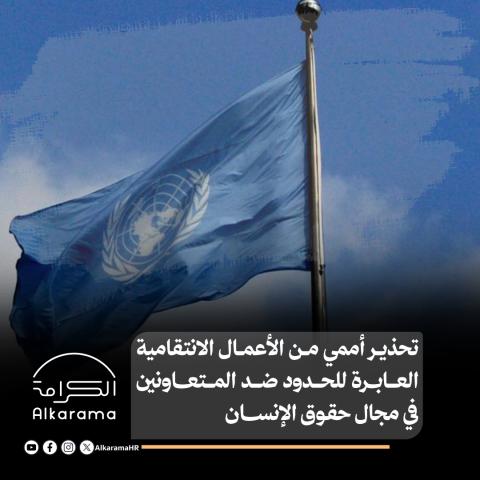
In a report published by Secretary-General António Guterres on Wednesday, 16 September 2026, the United Nations warned of the continued use of reprisals against human rights defenders, journalists, lawyers and trade unionists because of their cooperation or efforts to engage with United Nations mechanisms. The report documents cases in 32 countries, including several Arab countries.
The report identifies several forms of reprisals, including arbitrary detention, physical assaults, digital surveillance, passport confiscation and the intimidation of family members. It also warns of the growing use of counter-terrorism legislation and cybercrime laws to criminalise human rights work. Claudia Fuentes Julio, Assistant Secretary-General for Human Rights, stressed that protecting engagement between the United Nations and civil society was essential to the Organisation’s ability to fulfil its mandate.
The annual report, prepared pursuant to Human Rights Council resolution 12/2, provides civil society organisations with an opportunity to submit contributions and enrich the report with documented cases and testimonies. In this context, Alkarama submitted a contribution on 15 April 2026, presenting documented individual cases as well as an analysis of trends in repression across the Arab world. The contribution notably documented the case of Alkarama itself as a victim of reprisals, after the French Ministry of the Interior relied on unsubstantiated intelligence originating from Algeria and the United Arab Emirates to impose an entry ban on Professor Abbas Aroua, a co-founder of the organisation. The Paris Administrative Court ultimately annulled the decision in April 2026.
The contribution also documented two cases in Morocco. The first concerned environmental activist Mohamed Ataoui, who was dismissed from the public service after 32 years of service following his engagement with the Special Rapporteur on the environment. The second concerned blogger Saida Elalami, who was assaulted and subsequently transferred to a prison far from her family after Alkarama brought her case before the Working Group on Arbitrary Detention. The contribution also addressed the case of Lebanese national Ahmad Ali Mekkaoui in the United Arab Emirates, who has been mentioned in the Secretary-General’s reports since 2019, highlighting the deterioration of his situation despite a United Nations opinion finding his detention to be arbitrary.
Alkarama further raised concerns about an amendment to Algeria’s nationality law introduced in February 2026, which allows for the administrative withdrawal of activists’ nationality on the basis of broadly worded allegations. It also denounced the use of international counter-terrorism cooperation frameworks to enable democratic States to implement retaliatory measures on behalf of authoritarian States. Alkarama’s Director, lawyer Rachid Mesli, described this practice as a dangerous extension of transnational repression.
Against this backdrop, the United Nations report confirms the growing use of digital technologies to monitor, intimidate and silence those seeking to engage with international human rights mechanisms. It highlights the urgent need to strengthen protection for individuals engaging with the United Nations in digital spaces.
The United Nations also expressed concern over the continued misuse of legislation, including laws and regulations relating to counter-terrorism, cybercrime and national security, to criminalise essential civil society activities or impose further restrictions on their exercise. These are issues on which Alkarama has consistently raised concerns through its human rights work and efforts to promote the rule of law.