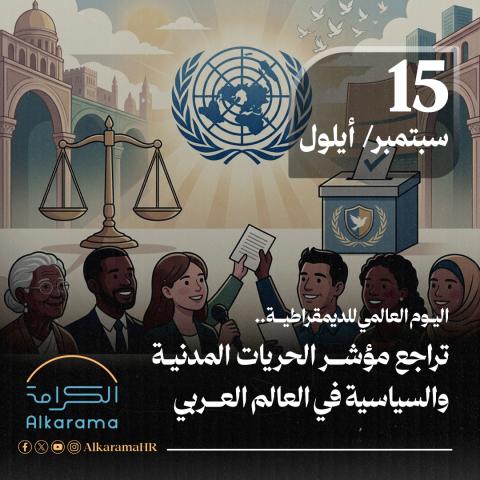
15 September 2026 marks the International Day of Democracy, proclaimed by the United Nations through General Assembly resolution 62/7, adopted on 8 November 2007, with the aim of promoting democratic systems. Democracy is founded on a range of human rights, foremost among them civil and political rights, including freedom of expression, freedom of association, the right to free elections and judicial independence. Promoting these rights in the Arab world has been one of Alkarama’s principal missions since its establishment.
The state of democracy in the Arab world has continued to deteriorate over the years, as reflected in various specialised international indices. According to the Economist Intelligence Unit, the research and analysis unit of The Economist Group, the Democracy Index for the Arab world in 2025 is among the lowest in the world, with a score of only 3.16 out of 10, below 4, the threshold below which regimes are classified as “authoritarian”. The index takes into account the electoral process and pluralism, the functioning of government, political participation, political culture and civil liberties. By comparison, the global average stands at 5.19, compared with 8.43 in Western Europe, 8.37 in North America, 5.71 in Latin America and the Caribbean, 5.33 in Eastern Europe and Central Asia, 5.27 in Asia and Australasia, and 4 in Sub-Saharan Africa.
The particularly low level of the Democracy Index in the Arab world reflects the catastrophic state of civil and political rights in most countries of the region. Regimes across the region are characterised by authoritarianism and repression, freedoms are stifled, political and media spaces are restricted, and citizens are arrested for the slightest expression of dissenting views. For more than two decades, Alkarama’s archives, which document these situations and bring cases before United Nations human rights mechanisms, have repeatedly borne witness to this structural pattern of repression across the region.
In the United Arab Emirates, for example, dozens of people detained in the so-called “UAE94” and “UAE84” cases remain arbitrarily detained, some even after having served the sentences originally imposed on them. This campaign of reprisals has also extended to the detainees’ own children. Alkarama’s 2026 annual report further documented acts of reprisal targeting Emirati dissidents and human rights defenders beyond the country’s borders, including through false intelligence notices used to obstruct them in the countries where they have sought refuge.
This example is but a glimpse of what Alkarama has documented across the different Arab countries through thousands of complaints and urgent communications submitted to the Working Group on Arbitrary Detention and United Nations Special Procedures. These cases all highlight a recurring pattern of the closure of civic and political space, the criminalisation of dissenting views and impunity for perpetrators of violations, explaining why the majority of Arab countries are classified as “authoritarian regimes” in international indices.
Since its establishment, Alkarama has worked to provide legal assistance to victims of repression in the Arab world, submit complaints concerning them to United Nations human rights mechanisms, and raise awareness of human rights.
On the occasion of the International Day of Democracy, it pays tribute to all those who defend the rights of Arab citizens and work towards democratic change and the establishment of a rule-of-law state that respects the civil and political rights of its citizens. On the occasion of the International Day of Democracy, Alkarama renews its call for the immediate release of all persons detained on account of their peacefully expressed views. It calls on Arab governments to open political and civic spaces to their citizens, guarantee the independence of the judiciary, and hold free and fair elections, with a view to achieving genuine democratic reform and moving the region away from the lowest positions it continues to occupy in global rankings of freedom and democracy.