
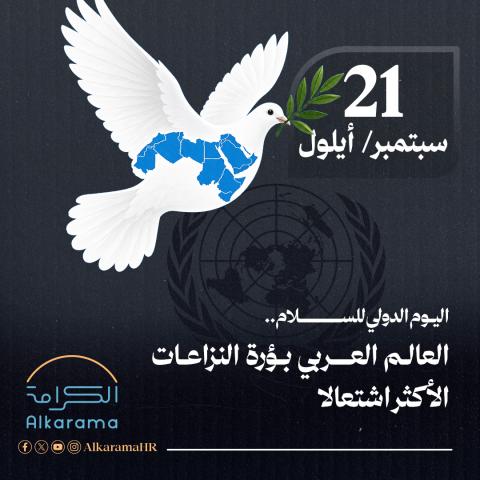
On 21 September 2026, the world marks the International Day of Peace, proclaimed by the United Nations General Assembly in its resolution 55/282 of 7 September 2001. The Day was established to promote a global day of ceasefire and non-violence through education and public awareness, and to support efforts towards achieving a worldwide ceasefire.
The Arab world remains one of the regions most severely affected by war and armed conflict. According to the Global Peace Index 2026, published by the Institute for Economics and Peace, the Middle East and North Africa once again ranks as the least peaceful region in the world. This is largely due to the wars and violence continuing to ravage Sudan, Yemen, Syria, Palestine, Iraq, Lebanon and Libya.
Peace and human rights are inseparable. Wars and armed conflicts result in serious violations of fundamental rights, foremost among them the right to life and physical integrity. They also drive displacement and forced population transfers, place vulnerable groups, particularly women and children, at heightened risk, and bring essential services to the point of collapse. For many communities, this means being deprived of the basic conditions necessary for a dignified life, with psychological consequences that may persist long after the fighting has ended. Conversely, lasting peace cannot be achieved without respect for human rights and human dignity, equality before the law and equal opportunities. Peace cannot be sustained where force prevails over the rule of law and the principles of justice are pushed aside.
This year, the United Nations has chosen the theme “Invest in Peace: For Everyone, Everywhere, Every Day”. As the Organisation notes, “Peace is more than the absence of war; it is the foundation necessary to collectively tackle humanity’s challenges. It is the lived experience of safety, dignity, opportunities and cooperation in our daily lives.”
Through its work with United Nations mechanisms, Alkarama has documented serious human rights violations committed in the context of armed conflicts. These include extrajudicial executions, enforced disappearances and acts of torture perpetrated by different parties to the conflicts, as well as the forced recruitment of children by non-state armed groups.
In Sudan, Alkarama has documented abductions, enforced disappearances and acts of torture attributed to the Rapid Support Forces, which it considers to reflect systematic practices rather than isolated incidents.
The Palestinian people, meanwhile, continue to endure extreme forms of violence and international crimes that may amount to war crimes and genocide under the Rome Statute. Peace is equally inseparable from respect for civil liberties and political participation. In 2025, the democracy index for the Arab region stood at just 3.16 out of 10, below the threshold for authoritarian regimes.
Alkarama, which works to promote peace in Arab societies through the defence of human rights, remains deeply concerned about the catastrophic situation in Arab countries affected by armed conflicts. It reiterates that peace is a fundamental necessity for individuals and peoples alike, and that it constitutes a fundamental human right. Genuine and lasting peace can only be achieved worldwide through respect for justice and dignity, and by ensuring the equality of all individuals and peoples before international law.
Alkarama calls for an end to impunity and for accountability to be ensured, for the fate of persons subjected to enforced disappearance to be established, for persons arbitrarily detained to be released, and for human rights defenders and all those cooperating with the United Nations and its mechanisms to be protected against acts of reprisal.