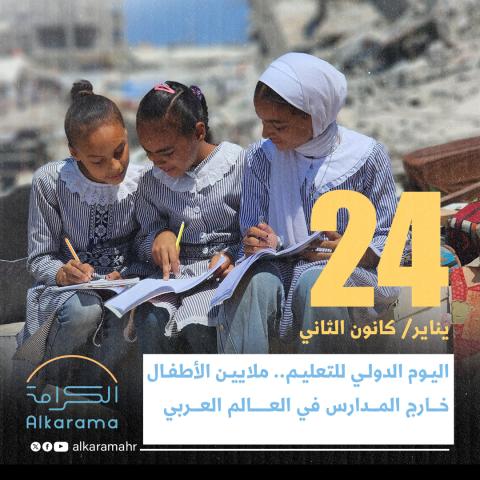
Today, the world marks the International Day of Education, proclaimed by the United Nations General Assembly on 3 December 2018, highlighting "the role of education in celebrating peace and development" and recognizing that “education is a human right, a public good and a public responsibility.” On this occasion, the United Nations Educational, Scientific and Cultural Organization (UNESCO), together with various regional partner organizations, is organizing numerous activities around the globe.
Education is recognized as a fundamental human right, enshrined in Article 26 of the Universal Declaration of Human Rights, which calls for free and compulsory elementary education, as well as in the Convention on the Rights of the Child, which provides that higher education shall be accessible to all. Furthermore, quality education constitutes the fourth of the seventeen Sustainable Development Goals that the United Nations is working to achieve by 2030.
Alkarama once again deplores the marked disparities that persist in the field of education among different Arab countries. While some States place major importance on the public and private education sectors, take advantage of modern technologies and invest heavily in the education of future generations, other countries do not give this vital sector the necessary attention and are experiencing a continuous deterioration of their education systems.
The education sector is also severely affected in Arab countries plagued by wars and violent conflicts, such as Palestine, Sudan, Yemen and Syria. The collapse of education systems and the destruction of schools and educational institutions deprive a large number of children of their right to education. This is compounded by the difficulties pupils and students face in accessing educational institutions in affected areas, the increase in forced displacement and migration, exposing children living in camps or unstable areas to interruptions in their schooling or to limited and irregular education.
UNESCO indicated in 2025 that "at least 30 million children out of school in the Middle East and North Africa", stressing that the crisis "drive a ‘staggering reversal’ of gains in learning in the region".
Alkarama reaffirms the central role of education in the development of societies and calls on governments to give this essential sector the highest priority, given its direct impact on the future of coming generations. This requires the mobilization of the necessary human and material resources to ensure quality education, as well as enhancing the status of teachers within society. Alkarama also calls on Arab governments and civil society organizations to strengthen their cooperation and solidarity in order to reduce disparities among Arab countries in the field of education.