
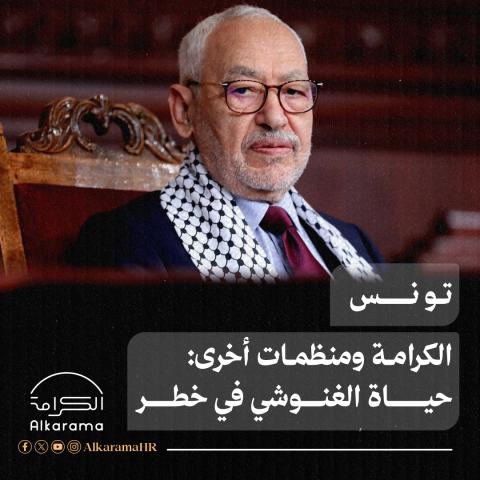
Alkarama and several other human rights organisations have warned that the life of Mr. Rached Ghannouchi, President of the Ennahdha Movement, former Speaker of Parliament and an 85-year-old political prisoner, is in real and imminent danger due to the serious deterioration of his health.
In this context, Alkarama recalls that it has repeatedly brought his case before United Nations human rights mechanisms and obtained Opinion No. 63/2025 of the UN Working Group on Arbitrary Detention, which found that his detention is arbitrary and called for his immediate release as well as an investigation into the violations committed against him. In light of the critical deterioration of his health, Alkarama has also submitted an urgent follow-up communication to the Working Group to inform it of these latest developments and to request that it intervene with the Tunisian authorities to ensure their prompt compliance with the Opinion by securing his release and, pending that, guaranteeing him access to adequate medical care.
In a joint statement, the signatory organisations, including Alkarama, reported that Mr. Ghannouchi has been hospitalised four times over the past month, as Tunisia experiences an exceptional heatwave. They further stated that his condition continues to worsen: his blood pressure remains unstable, he suffers from severe pain in his left leg and sleep apnoea, and he recently lost consciousness in detention as a result of heat exhaustion.
For its part, Rached Ghannouchi's defence team, whose statement was shared with Alkarama, condemned the Tunisian authorities' refusal to allow him to receive any visits, whether from his lawyers or family members, following the severe collapse and loss of consciousness he suffered last Friday. The defence team considers this ban to be a flagrant violation of his right to communicate with his lawyer and family and holds the authorities fully responsible for his physical safety and health.
The signatory organisations stressed that denying a detainee access to appropriate medical care or continuing to detain a person whose life is at serious risk may amount to cruel, inhuman or degrading treatment, in violation of the international treaties ratified by Tunisia. They called on the Tunisian authorities to immediately and unconditionally release Rached Ghannouchi, along with all political prisoners and prisoners of conscience, to guarantee their unrestricted access to their lawyers and families, and to put an end to the misuse of the justice system against political opponents, journalists and human rights defenders.
Text of the joint statement:
The undersigned human rights organisations express their deep concern over the serious deterioration of the health of political prisoner Sheikh Rached Ghannouchi, aged eighty-five, who is currently receiving treatment in hospital after being transferred there several times in recent weeks, amid an exceptional heatwave in Tunisia that poses particularly severe health risks to elderly people and those suffering from chronic illnesses.
These developments come against the backdrop of the continued detention of dozens of political opponents, judges, lawyers, journalists, activists and human rights defenders in proceedings that have been widely criticised by international human rights bodies due to violations of fair trial guarantees and defence rights, the excessive use of prolonged pretrial detention, and the use of broadly worded legal provisions to criminalise peaceful political activity and freedom of expression.
Rached Ghannouchi's health continues to deteriorate. Available information indicates that he recently lost consciousness in prison as a result of heat exhaustion. His blood pressure remains unstable, the symptoms of Parkinson's disease have worsened and now also affect his hands. He also suffers from severe pain in his left leg, sleep apnoea and extreme fatigue aggravated by the high temperatures. Having been transferred to hospital four times during the past month, where he remains under medical treatment, it is evident that his condition can no longer be adequately managed within the prison environment.
The seriousness of the situation is further compounded by his advanced age, the prison sentences imposed on him in several cases, and the additional prosecutions he continues to face as part of a broader campaign targeting opposition leaders, including Mr. Ahmed Nejib Chebbi and a number of other political figures and human rights defenders. These prosecutions have drawn widespread criticism from United Nations experts and international organisations, which consider them to be incompatible with the fundamental rights guaranteed under international human rights law.
The organisations also express their grave concern over reports that Mr. Rached Ghannouchi's lawyers and family members have been prevented from visiting him during his hospitalisation. If confirmed, such measures would constitute a clear violation of the right to legal counsel, the right to communicate with one's family, and the right to independent oversight of detention conditions and medical care. These rights may only be restricted in the most exceptional circumstances and strictly in accordance with the principles of necessity and proportionality established by law.
The organisations recall that the Republic of Tunisia is a party to the International Covenant on Civil and Political Rights, the International Covenant on Economic, Social and Cultural Rights, the Convention against Torture and the African Charter on Human and Peoples' Rights. These treaties require the State to protect the right to life, the right to health, respect for human dignity, access to appropriate medical care for all persons deprived of their liberty, and their right to communicate with their lawyers and families, as also reflected in the United Nations Standard Minimum Rules for the Treatment of Prisoners (the Nelson Mandela Rules).
The organisations stress that denying detainees appropriate medical care or keeping them in detention despite serious risks to their lives may amount to cruel, inhuman or degrading treatment, prohibited under the international treaties by which Tunisia is bound.
In light of the above, the signatory organisations call on the Tunisian authorities to:
immediately and unconditionally release all political prisoners and prisoners of conscience in Tunisia;
immediately release Rached Ghannouchi in view of his critical health condition, advanced age and the serious risks to his life; release Mr. Ahmed Nejib Chebbi and the other opposition leaders detained solely for the peaceful exercise of their civil and political rights;
ensure that all detainees have prompt and non-discriminatory access to the specialised medical care they require;
guarantee that detainees are able to communicate freely and regularly with their lawyers and family members, while fully respecting all fair trial guarantees;
end the use of the criminal justice system to prosecute political opponents, activists, journalists and human rights defenders, and fully comply with international standards relating to judicial independence and the rule of law.
The signatory organisations warn that the continued detention of elderly and seriously ill detainees under these conditions, together with the rapid deterioration of their health, could lead to tragic consequences for which the Tunisian authorities would bear full legal and moral responsibility.
They also renew their call on the international community, the Office of the United Nations High Commissioner for Human Rights, the United Nations Special Procedures and the African Commission on Human and Peoples' Rights to intensify their monitoring of the human rights situation in Tunisia and to take all necessary measures to ensure that the Tunisian authorities comply with their international obligations and protect the fundamental rights of all detainees.
Signatory organisations:
Alkarama – Geneva
Association of Victims of Torture – Geneva
Al Shehab Center for Human Rights – London
Sawt Hor for Human Rights – Paris
SAM for Rights and Liberties – Geneva
Solidarity for Human Rights – Geneva
Najda Organization for Human Rights
Human Rights Monitor – London IFDI International