
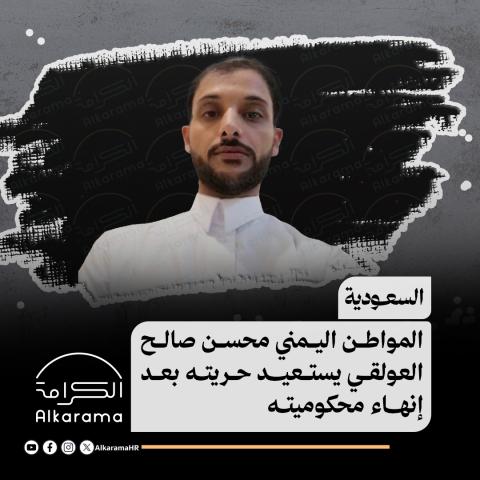
Alkarama has learned that the Saudi authorities have released Yemeni national Mohsen Saleh Nasser Al-Awlaki, who is expected to return to Yemen after spending five years and four months in the Kingdom’s prisons. He had been convicted on charges of adhering to “deviant ideas” and supporting a religious group linked to “Ansar al-Mahdi”.
In its Opinion No. 1/2025, adopted on 1 April 2025, the United Nations Working Group on Arbitrary Detention (WGAD) found that Mr Al-Awlaki’s detention was arbitrary and involved multiple violations of international law. The Opinion followed a complaint submitted by Alkarama on 23 October 2024 concerning the arrest of the construction worker in May 2021 in Saudi Arabia.
Mr Al-Awlaki was arrested in Riyadh on 26 May 2021, without an arrest warrant or being informed of the reasons for his arrest. The sole conduct for which he was prosecuted was the expression of his religious beliefs on social media, including his alleged support for a religious group linked to “Ansar al-Mahdi”.
He was subsequently held incommunicado for three months, without any contact with his family or access to a lawyer. According to the United Nations Working Group, this treatment constituted a clear violation of his right to liberty and due process guarantees.
The Working Group further found that Mr Al-Awlaki’s statements contained no call to violence and amounted to the peaceful exercise of his freedom of conscience and expression, as guaranteed by Articles 18 and 19 of the Universal Declaration of Human Rights. Nevertheless, his alleged affiliation with a minority religious movement at odds with the official doctrine in Saudi Arabia had been sufficient to justify his conviction.
In November 2022, Mr Al-Awlaki was sentenced by the Specialized Criminal Court to 20 years’ imprisonment and 80 lashes. In mid-2025, however, the court overturned the previous judgment and reduced the sentence to six and a half years’ imprisonment, with one year suspended, running from the date of his arrest. The time already spent in detention was therefore taken into account.
Alkarama’s Action
Acting on a mandate from Mr Al-Awlaki’s family, Alkarama had brought his case before the United Nations Working Group on Arbitrary Detention, denouncing the manifest disregard for international standards relating to the right to a fair trial and, consequently, the arbitrary nature of his detention.
Alkarama stressed that this arbitrary deprivation of liberty did not concern Mr Al-Awlaki alone. It noted that Riyadh had conducted a wide-ranging campaign of repression against activists, religious figures, journalists, bloggers, businesspeople and, more generally, anyone who peacefully expressed views on social media that were contrary to the government’s official policy. This campaign had intensified following the Crown Prince’s rise to power.
Alkarama called on the Working Group to recognise the arbitrary nature of Mr Al-Awlaki’s deprivation of liberty and to urge the Kingdom of Saudi Arabia to release him.
In its Opinion, the Working Group concluded that Mr Al-Awlaki’s detention was based on ideological and political considerations, thereby constituting a form of discrimination prohibited under international law. It called on the Saudi authorities to release him immediately, provide him with reparation, open an independent investigation and undertake comprehensive reform of the country’s judicial system.
The Working Group also recommended a full investigation into the circumstances of his arbitrary detention and the adoption of appropriate measures against those responsible for violating his rights. It further referred the case to the Special Rapporteur on freedom of religion or belief and the Special Rapporteur on the protection of human rights while countering terrorism.
In this context, Alkarama once again urges the Saudi Government to expedite the release of all prisoners of conscience, particularly those who are the subject of opinions issued by the Working Group on Arbitrary Detention.
It also recalls its letter addressed to the Saudi Human Rights Commission, the Kingdom’s national human rights institution, in which it called on the Commission, within the framework of its mandate, to promote and ensure the effective implementation of a number of opinions issued by the United Nations Working Group on Arbitrary Detention, as well as decisions of the Committee on the Rights of Persons with Disabilities (CRPD) concerning the Kingdom of Saudi Arabia.