
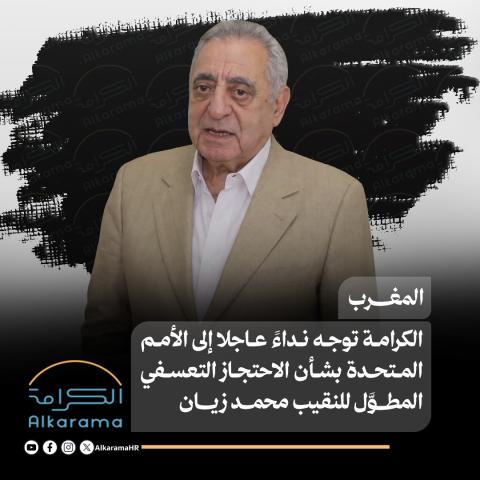
Alkarama has submitted an urgent appeal to the United Nations Special Rapporteur on the independence of judges and lawyers and the Special Rapporteur on the situation of human rights defenders on behalf of Mr. Mohamed ZIAN, an 83-year-old lawyer detained in Morocco since 21 November 2022. Alkarama called on the independent experts to intervene without delay with the Kingdom of Morocco, including by means of a press release, to call for his release or, at the very least, for the adjustment of his sentence on humanitarian and medical grounds, measures that the Human Rights Committee has been requesting in vain since February 2024.
A former President of the Rabat Bar Association, Minister for Human Rights from 1995 to 1996 and founder of the Moroccan Liberal Party, Mr. ZIAN served in full, on 21 November 2025, a three-year prison sentence imposed, at the end of a manifestly unfair trial, on eleven disparate charges criminalising his court pleadings and his public statements.
He remains in detention beyond that first sentence, under a second set of proceedings, brought while he was already in prison, for an alleged embezzlement of public election funds that the Court of Auditors, the only competent institution, has never found to have occurred. Sentenced to five years on 8 April 2026 by the court to which the case was remitted after cassation, he has again appealed to the Court of Cassation, and two applications for provisional release were rejected in February and June 2026. His detention now rests solely on a committal order devoid of any valid factual or legal grounds and on a conviction that is not final. Yet, this sentence could keep him in prison until 21 November 2030, when he would be 87 years old. Suffering from heart and kidney failure, he has lost thirty kilograms since the beginning of his detention. Since 11 June 2026, he has also been subject to a disciplinary sanction that was never notified to him in writing and which has deprived him of outdoor exercise and of access to his prison money, and therefore of any purchase of necessary food items from the prison shop.
In its submission, Alkarama stressed the humanitarian urgency of the situation of Mr. ZIAN, who is elderly and seriously ill, and who remains in detention for having defended prisoners of conscience. Morocco has explicitly refused to implement the interim measures requested by the Human Rights Committee, and each passing week increases the risk of irreparable harm to the former Bar Association President’s life.
A confidential procedure that has remained without effect for thirty months
The special procedures of the Human Rights Council, independent experts mandated by the United Nations, can address urgent appeals to governments, make them public and take a position on individual cases without waiting for the outcome of domestic remedies. The appeal filed today, copied to the Working Group on Arbitrary Detention and to the mandate holders on freedom of expression, the rights of older persons, the right to health, torture and the right to privacy, complements an individual procedure that has been pending for more than two years before the Human Rights Committee and that remains confidential until the final decision.
Seized by Alkarama in February 2024, the Committee had, as early as 28 February 2024, requested the Government of Morocco, by way of interim measures, to adjust Mr. ZIAN's sentence on humanitarian and medical grounds and to protect him, his counsels and his family from any reprisals. By note verbale of 25 June 2024, the Government replied that this request "exceeds the competence of the Committee" and asked for it to be withdrawn. On 22 July 2026, having been informed of the disciplinary sanction, the Committee recalled that these measures remained in force and requested the State to "ensure that Mr. Mohamed ZIAN has effective access to adequate food, sufficient hydration and the medical care required by his state of health and his age" and to "refrain from any action likely to further compromise the author's physical integrity or to constitute reprisals against him, his family or his counsel". Morocco was to report on their implementation by 24 August 2026; to date, none of these measures has been implemented.
Prosecuted for his pleadings, convicted in his absence and arrested without a warrant
The proceedings against Mr. ZIAN began in the very exercise of his duties as defence counsel. As the lawyer of Nasser ZEFZAFI, a leading figure of the Rif protest movement, and of the journalist Taoufik BOUACHRINE, he was suspended three times at the initiative of the public prosecutor's office, against the opinion of the President of the Bar and of the Bar Council, for acts of defence. As early as 2018, the Working Group on Arbitrary Detention (WGAD) had found that the proceedings brought against him had undermined Mr. BOUACHRINE's defence rights. In November 2021, on a complaint by the Ministry of the Interior, he was sent for trial on eleven unrelated offences, ranging from "contempt of magistrates" and "disparagement of judicial decisions" to "complicity in adultery", on the basis in particular of a video circulated by a website close to the intelligence services, which an independent expert examination found to have been tampered with. The only one of Mr. BOUACHRINE's twenty-nine lawyers to have been prosecuted, he was sentenced to three years' imprisonment on 23 February 2022, then on appeal on 21 November 2022, at the end of a single hearing held in his absence and in that of his lawyers, due to irregular summons. Arrested that same evening without a warrant, at the office of his son and lawyer, he was not served with the committal order until eight days later.
A complaint dismissed, then reopened to keep him in detention
The second case rests on a complaint filed in 2021 by the new leader of his party and political rival, concerning the public funding of the 2015 election campaign. Dismissed by the competent authority "for lack of evidence" on 30 October 2023, it was filed again five weeks later, without any new element, even though the Constitution reserves the oversight of party finances to the Court of Auditors, and the latter had recorded the full repayment of the sums at issue.
Sentenced to five years' imprisonment in July 2024, then to three years on appeal on 7 May 2025, Mr. ZIAN applied for his sentences to be served concurrently; this was refused on 26 November 2025. The Prosecutor General had publicly announced the day before that his detention would continue until the second case had been finally decided. On 18 December 2025, the Court of Cassation quashed the judgment on his appeal alone and on 8 April 2026, the court to which the case was remitted reinstated the five-year sentence, thereby increasing it. The court refused to apply two new laws, in force since December 2025 and January 2026, which give the Court of Auditors the exclusive power to refer matters concerning election funds to the public prosecutor.
Denied medical care, then denied adequate food for having defended fellow prisoners
The former Bar Association’s President's family has reported to human rights organizations a continuous deterioration in his state of health. After cardiac episodes in February and April 2024, he was only to be transferred to hospital on condition that he be handcuffed and wear the prison uniform, which he refused, as this treatment was incompatible with his dignity and his state of health.
The handcuffing requirement was lifted only after a serious fall, with almost a year's delay in his medical follow-up. While even his lawyers are regularly targeted by sanctions from the authorities, on 11 June 2026 Mr. ZIAN was deprived of outdoor exercise and of access to the prison shop, without any written record, hearing or notification; on 17 June. The prison administration stated that it was punishing, with a thirty-day ban on purchases, the "use of the establishment's landline telephone for purposes other than those intended", namely a call with his lawyer during which, according to his family, he denounced the fate of fellow prisoners who had suffered violations. The appeal lodged on 15 June has gone unanswered, and his condition has deteriorated further since then.
Reprisals against a former President of the Bar, in a background of legal crackdown on lawyers
The treatment of Mr. ZIAN illustrates the growing restrictions on the legal profession, and on freedom of expression in general, in Morocco. The Kingdom is a party to the International Covenant on Civil and Political Rights, which guarantees the rights to life, liberty and security of person as well as freedom of expression and association. Yet the proceedings against the former Bar Association’ President target, among other things, statements made by the lawyer in the course of his work defending political cases, in breach of the State's obligation to respect these fundamental rights. Moreover, the Nelson Mandela Rules expressly prohibit the reduction of a prisoner's diet or drinking water as a sanction and require that prisoners receive adequate health care. Finally, the United Nations Basic Principles on the Role of Lawyers guarantee lawyers immunity for statements made in good faith in their pleadings and reserve their discipline to an impartial disciplinary body of the Bar.
As early as 2016, the Human Rights Committee expressed concern about arbitrary disciplinary measures against lawyers, and in December 2025 it questioned Morocco on their protection from reprisals in preparation for the Committee's forthcoming review of the country. In February 2026, the Special Rapporteur on the independence of judges and lawyers had asked the Government to urgently review the provisions of Bill No. 66.23 that give the public prosecutor's office a central role in the discipline of lawyers and restrict their freedom of expression.
Yet the law was promulgated on 18 August 2026, despite the open-ended strike of the bar associations, enshrining the practice of which Mr. ZIAN was the first victim. Mr. ZIAN's case is therefore not an isolated one. In an increasingly restrictive context, it reads as a message to all lawyers in the country who defend journalists and political opponents that they too will be brought into line. As the State party is due shortly to present its seventh periodic report to the Human Rights Committee, releasing Mr. ZIAN before it is too late would be a first sign of greater respect by the Government for its international obligations.
The urgent appeal stresses the need for the Kingdom's authorities to release Mr. ZIAN immediately, at the very least pending the examination of his appeal to the Court of Cassation, or, in the alternative, to adjust his sentence so that it is served outside prison. In accordance with the Committee's interim measures, the State must guarantee the former Bar Association’s President an independent medical assessment, access to specialized care without handcuffing, adequate food and hydration and the lifting of any sanction or restriction on the exercise of his rights in detention, and must refrain from any intimidation or reprisals against him, his family and his lawyers.
What is next?
The urgent appeal will be transmitted to the Moroccan Government through the Office of the United Nations High Commissioner for Human Rights, which invites it to respond to the experts and to take the measures requested. After a period of sixty days, the appeal and any reply from Morocco are made public in the special procedures' communications database, and then in the joint communications report presented to the Human Rights Council. The experts may, at any time, make their intervention public through a press release.
In parallel, the case remains pending before the Human Rights Committee, which requested in February 2024, and reiterated in July 2026, protective measures intended to preserve the former Bar President's life, starting with his release from prison. These requests have gone unheeded. This is why Mr. ZIAN's counsel considered it necessary for independent experts to publicly remind Morocco of its international obligations.
Far from seeking a favour for a former Bar President and former minister, the aim is to recall that this status cannot, conversely, deprive him of his freedom of opinion and expression, of his right to liberty and of his right to be treated with dignity in detention.