
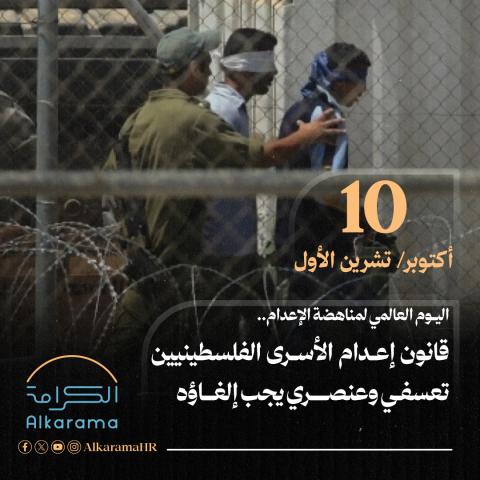
On the occasion of the World Day Against the Death Penalty, observed on 10 October, the undersigned organisations reaffirm their opposition to any abusive use of this penalty, under any circumstances, and strongly condemn the law adopted by the Israeli Knesset, on 30 March 2026, by 62 votes to 48. This law establishes hanging as the default penalty for Palestinians convicted by military courts of killing Israelis in acts classified as terrorism. It allows judges to substitute a life sentence only in exceptional circumstances and permits the imposition of a death sentence without unanimity among the judges.
We stress that this law is discriminatory both in its design and in its effects. Military courts try only Palestinians in the occupied West Bank, whereas settlers are subject to civilian courts and are not subject to the mandatory death penalty. The most severe punishment is thus reserved for a specific category of persons, in violation of the principle of equality before the law enshrined in Articles 2 and 26 of the International Covenant on Civil and Political Rights, to which Israel acceded in 1991.
United Nations experts have repeatedly warned of the risks associated with this development. In February 2026, they called on Israel to withdraw the bill, stressing that the mandatory death penalty is arbitrary by nature and that involuntary manslaughter does not fall within the category of “most serious crimes” for which international law permits the use of capital punishment. In January 2026, the United Nations High Commissioner for Human Rights, Volker Türk, reiterated the United Nations' opposition to the death penalty in all circumstances and urged Israel to abandon these proposals.
Following the adoption of the law, several Special Rapporteurs, including Morris Tidball-Binz, Special Rapporteur on extrajudicial, summary or arbitrary executions, and Francesca Albanese, Special Rapporteur on the situation of human rights in the Palestinian territories occupied since 1967, denounced a discriminatory capital punishment regime constituting a flagrant violation of Israel's international obligations. They demanded the immediate repeal of the law and called on Israel not to implement it. They also recalled that the trial of civilians by military courts that do not comply with fair trial standards renders any death sentence imposed by those courts unlawful. Finally, they stressed that this law forms part of a context in which the International Court of Justice has concluded that Israel's legislation and measures in the occupied Palestinian territory violate the prohibition of apartheid.
The gravity of this law also stems from the fact that the Knesset has no legislative jurisdiction over the occupied territory and that military courts themselves have been implicated in practices of arbitrary detention, torture, extortion of confessions and violations of fair trial guarantees. These violations have been documented by the Committee against Torture, the Independent International Commission of Inquiry and other United Nations bodies. In such a context, the death penalty, which is irreversible by nature, risks becoming an instrument of killing beyond any effective judicial control. Despite the criticism expressed and the legal challenges brought by Israeli human rights organisations before the Israeli Supreme Court, seeking the annulment of the law and the provisional suspension of its implementation, the Court has not ordered such a suspension, according to the latest information whose accuracy we have been able to verify.
We believe that the Court must, in accordance with the call made by United Nations experts, invalidate this legislation without delay, before irreparable harm is caused. Furthermore, the incitement to hatred that accompanied the adoption of the law, particularly statements made by ministers in the Israeli government, shows that this measure serves a political logic of revenge rather than the imperatives of justice.
Accordingly, the undersigned organisations call for:
The immediate repeal of the law and the cessation of all its implementation, as well as a commitment not to seek, impose or carry out any death sentence on its basis;
An end to the trial of Palestinian civilians before military courts and the guarantee of fair trials in accordance with international standards;
The opening of investigations into allegations of torture and ill-treatment inflicted on Palestinian detainees, as well as the holding of those responsible to account;
States to comply with their obligations under international law, including by refusing to recognise the effects of this legislation and mobilising all means at their disposal to exert pressure for its repeal;
Continued monitoring of the implementation of this law by the Office of the United Nations High Commissioner for Human Rights and the United Nations Special Procedures, as well as the submission of information on this matter to the Human Rights Council.
The undersigned organisations recall that the right to life must not be subject to any discrimination, that the use of the death penalty in situations of armed conflict contributes neither to justice nor to deterrence, and that its extension to a people living under occupation constitutes a serious setback to the global movement towards abolition.
Signatory organisations:
Alkarama – Geneva
Adala Organisation for Human Rights – Istanbul
EAFORD International – Belgium
Victims of Torture – Geneva
Sawt Hor for Human Rights – Paris
Tawasol for Human Rights – The Hague
Council of Egyptians for Human Rights – Geneva
Al-Tadhamon for Human Rights – Geneva