
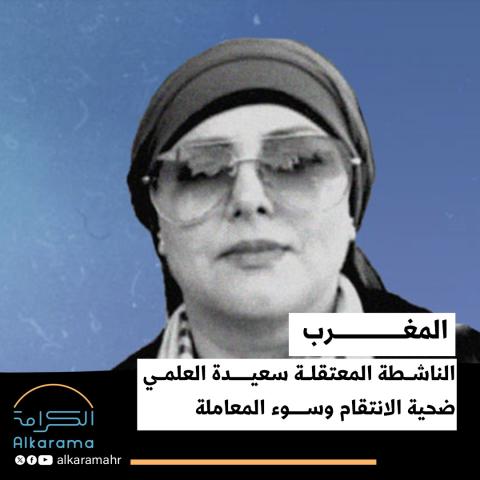
The Moroccan activist Saida El Alami, currently detained at El Oukacha Prison in Casablanca, has recently been subjected to serious ill-treatment by prison staff, in a context revealing acts of reprisals linked to her recourse to United Nations mechanisms.
By a judgment rendered on 17 December, the Casablanca Court of Appeal upheld the three-year prison sentence imposed on Ms. El Alami at first instance.
The incidents occurred in the days following this decision, at a time when her situation was already the subject of an international procedure, as Alkarama had submitted a request for an opinion to the United Nations Working Group on Arbitrary Detention (WGAD) on 16 October.
Saida El Alami, victim of ill-treatment in detention
On 25 December, during a routine search, Ms. El Alami was questioned by female prison guards about the referral of her case by Alkarama to the WGAD. After confirming these steps, she was physically assaulted by several guards, in front of other detainees and was subjected to explicit threats of further judicial proceedings. Her clothes and personal belongings were deliberately torn and soaked, leaving her without any possibility of changing.
These events occurred after Alkarama had submitted a request for an opinion to the WGAD and after the Moroccan State had been officially notified of this communication within the framework of the adversarial procedure. The context, chronology and very nature of the violence clearly establish that Ms. El Alami was deliberately targeted in direct reprisal for having exercised her legitimate right to seek recourse to international human rights protection mechanisms.
Failure by Morocco to comply with its conventional obligations
Such acts constitute serious violations of the International Covenant on Civil and Political Rights (ICCPR), in particular the provisions prohibiting cruel, inhuman or degrading treatment, as well as the Nelson Mandela Rules, which guarantee the protection of the physical integrity and dignity of persons deprived of their liberty. They also engage the international responsibility of Morocco under the Convention against Torture, to which it is a State Party.
Alkarama is closely monitoring the situation of Ms. Saida El Alami and recalls that Morocco is required, under its international commitments, to prevent, investigate and punish any act of torture, ill-treatment and any measure of reprisal.
In the absence of effective guarantees, and should these violations continue or worsen, the victim reserves the right to refer the matter to the United Nations Committee against Torture (CAT), a body that has already examined similar failures by Morocco in the implementation of its international obligations.