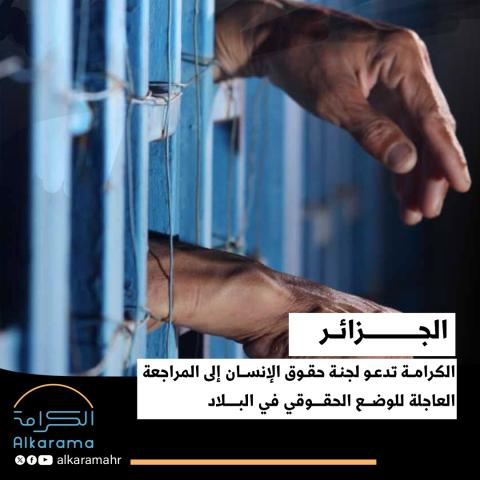
In view of the deteriorating human rights situation in Algeria, Alkarama called on the Human Rights Committee to urgently schedule the examination of the situation and to urge Algeria to submit its overdue periodic report.
This situation must be considered in the broader context in which it arises. Since the military seized power in the 1990s, Algeria has experienced sustained political repression. Nevertheless, the popular Hirak movement in 2019 raised hopes of a democratic opening. However, rather than moving in that direction, the following years were characterised by an intensification of repressive practices, including the arbitrary arrest of demonstrators, journalists and human rights defenders, the systematic use of emergency legislation and a subservient judiciary, severe restrictions on fundamental freedoms, and documented cases of torture and ill-treatment.
None of the recommendations made by experts during Algeria’s last periodic review have been implemented by the state; in fact, it has moved in the opposite direction by generalising violations of Algerian citizens’ fundamental freedoms and reinstating practices that were believed to have been consigned to the past since the civil war of the 1990s.
Notably, the Algerian authorities have extended the application of Article 87 bis of the Penal Code, in violation of UN expert recommendations, by using it against journalists, members of the political opposition, human rights defenders and individuals expressing critical opinions of the political authorities on social media. Nevertheless, the Human Rights Committee urged the Algiers authorities to 'define acts of terrorism precisely and ensure that counter-terrorism provisions are not used to limit the rights enshrined in the Covenant, particularly against human rights defenders and journalists'.
Moreover, in the context of following up on its decisions, the Human Rights Committee urged the State party “to cooperate in good faith with the Committee under the individual communications procedure and [...] to take all necessary measures to establish appropriate procedures to give full effect to the Committee’s views, in order to guarantee an effective remedy in the event of a violation of the Covenant”.
However, the Algerian authorities have not implemented any of the Committee's decisions, flagrantly violating their international obligations. In fact, reprisals have been taken against certain complainants or members of their families to deter individuals from cooperating with the Committee or resorting to its complaints mechanism.
Against this backdrop, on 1 December 2025, Alkarama submitted a detailed and updated report to the UN body, identifying all instances in which the State party has failed to comply with its international obligations under the International Covenant on Civil and Political Rights. Furthermore, during its 2018 review, the Committee called on the Algerian authorities to 'ensure the unconditional release of any person arbitrarily detained and to open effective and independent investigations into any allegation of arbitrary arrest'.
It should be emphasised that several dozen individuals, who were sentenced to lengthy prison terms in the 1990s following unfair trials before exceptional jurisdictions (special courts) based solely on confessions extracted under torture, continue to be detained in inhumane conditions after more than 30 years.
Djameleddine Laskri, a 65-year-old architect, has been detained for 33 years following his conviction on 26 May 1993 by the Algiers Special Court. This conviction was based solely on confessions extracted under torture during two months of incommunicado detention. Despite this, a decision was adopted by the United Nations Working Group on 30 April 2014 recognising the arbitrary nature of his detention and ordering his immediate and unconditional release.
This persistent refusal to implement the Committee's decisions, as well as those of all other UN mechanisms in favour of victims, consolidates a system of impunity that has become structural. The lack of serious attempts to comply with international obligations is an alarming sign of the erosion of the rule of law in the country. Current violations are not isolated incidents, but part of a continuum of deeply entrenched repressive methods and structures.
In the absence of guarantees of non-repetition, independent oversight, or institutional reforms, Algerian citizens remain exposed to a real risk of repetition of these violations, including the most serious ones. The total refusal to execute the Committee’s decisions is not merely a legal failure, but also directly contributes to the normalisation and repetition of these abuses.
Alkarama reaffirms its determination to continue its work of documentation, legal assistance and engagement with international human rights mechanisms in order to contribute to the effective realisation of the rights enshrined in the Covenant in Algeria.