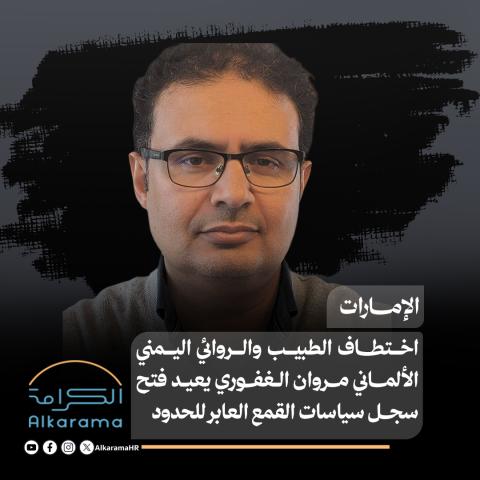
The detention of Yemeni-German novelist and physician Dr Marwan Al-Ghafouri, coupled with the requirement that he issue a public apology as a condition for leaving the United Arab Emirates, raises serious concerns about the State’s practices of targeting journalists and activists who speak out against its human rights record.
This incident also brings renewed attention to repressive policies that extend beyond the persecution of dissenting voices within the country and reach across its borders through what is known as transnational repression. This includes situations in which writers, journalists or human rights defenders face the risk of detention, humiliation and threats of imprisonment because of their opinions and public statements.
The message conveyed by such practices extends far beyond the individual directly targeted. It is intended to deter anyone who might consider criticising Emirati policies or denouncing the violations associated with them, including policies and practices involving alleged complicity in serious violations and support for actors accused of committing war crimes.
The facts
The Emirati authorities arrested Yemeni-German novelist and physician Dr Marwan Al-Ghafouri before allowing him to leave the country for Germany on the evening of Friday, 13 November, following approximately one and a half to two days of incommunicado detention. The authorities neither officially acknowledged his arrest and detention nor informed his family or the German Embassy of his whereabouts. Before his departure, he appeared in a video in which he apologised to the ruler of the United Arab Emirates and its people for the “offences” he had allegedly committed. This episode recalls the series of recorded apologies that other detainees in the Gulf have been forced to make before being released.
Contact with Al-Ghafouri was lost on the morning of Thursday, 12 November, while he was on his way to Dubai Airport after attending the Sharjah International Book Fair as an invited guest. He never boarded his flight to Düsseldorf. His wife, writer Sarah Yassine, made a public appeal to the ruler of Sharjah, while the German Embassy intervened and the hashtag “Where is Marwan Al-Ghafouri?” spread widely.
Following his release, Al-Ghafouri explained in a video lasting approximately 25 minutes that security officers had confiscated his passport, telephone and watch at the airport before transferring him to Abu Dhabi, where he was brought before a court specialising in cybercrime cases. The investigator reportedly presented him with a file containing publications dating from 2011 to 2019, which had been classified as “insulting” to State symbols. He was reportedly notified of two charges: “disseminating misleading information”, punishable by one year’s imprisonment and a fine of AED 100,000, and “insulting State symbols”, punishable by five years’ imprisonment and a fine of AED 500,000.
He was then reportedly forced to choose between continuing the judicial proceedings against him and having his case closed in exchange for issuing a public apology. He chose to apologise. He also recounted that his hands had been handcuffed, that he had been transported in a prison van, dressed in a blue prison uniform and forced to spend the night sleeping on the floor of a prison mosque. This account is incompatible with the authorities’ portrayal of his release as an act of “hospitality”. It confirms that his detention was real and organised, and that the authorities only acknowledged it after securing his apology.
Renewed human rights and legal concerns
The Al-Ghafouri case brings back into focus the legal and human rights concerns that Alkarama has repeatedly raised regarding the United Arab Emirates’ human rights record and its legislative framework. In carrying out his arrest, the authorities relied on Federal Decree-Law No. 34 of 2021 on Countering Rumours and Cybercrimes. This legislation uses vague terms such as “misleading information”, “offence” and “State symbols”, while providing for custodial sentences and heavy fines for peaceful expression. Such provisions are incompatible with the principle of legality, which requires offences and penalties to be clearly defined, as well as with Article 19 of the Universal Declaration of Human Rights, which guarantees freedom of opinion and expression. They also fail to meet the requirements of necessity and proportionality. International law affords heightened protection to criticism directed at political leaders and public institutions, which cannot legitimately be criminalised.
This problem is not confined to this legislation. Alkarama has also repeatedly raised concerns about other laws, including Law No. 7 of 2014 on Combating Terrorism Offences, whose particularly broad definitions allow peaceful political opposition to be equated with offences against national security. These provisions provide security services with a legal pretext to carry out arrests and prosecutions without independent judicial oversight.
As for detention that is not officially acknowledged, where the family is not informed of the detained person’s whereabouts, this constitutes an enforced disappearance within the meaning of the United Nations Declaration on the Protection of All Persons from Enforced Disappearance, regardless of its duration. It constitutes a violation of Article 14 of the Arab Charter on Human Rights, which the United Arab Emirates has ratified, and also breaches its obligations under the Convention against Torture.
A record closely monitored by Alkarama
For several years, Alkarama has monitored the practices of the Emirati authorities towards journalists, writers and human rights defenders, and has submitted individual complaints concerning many of them to the United Nations Special Procedures. This repression does not stop at the country’s borders but extends to the persecution of critics abroad, including through security cooperation with other States. One such case is that of poet Abdul Rahman Al-Qaradawi, who was extradited to the United Arab Emirates from Lebanon in January 2025 after being arrested because of his poems and political statements.
The case of Emirati businessman Khalaf Abdulrahman Al-Rumaithi is another particularly revealing example. Sentenced in absentia to 15 years’ imprisonment in the “UAE 94” case, he was arrested in the Jordanian capital, Amman, on 7 May 2023, upon arriving from Türkiye, of which he is also a national. He was subsequently released on bail and ordered to appear before the court on 16 May 2023. However, before that date, the Jordanian authorities rearrested him and handed him over to Abu Dhabi, in violation of the Convention against Torture, to which Jordan is a party, as well as its Constitution and domestic legislation. The Emirati authorities acknowledged receiving him and described him as a “terrorist”, referring to the Federal Supreme Court’s 2013 judgment in Case No. 79/2012, which had sentenced him to 15 years’ imprisonment for “establishing a secret organisation”.
The United Nations Office of the High Commissioner for Human Rights expressed serious concerns about the risk of ill-treatment to which he might be exposed and urged the UAE to release all those imprisoned for exercising their rights to freedom of expression and association.
The “UAE 94” case itself led, in 2013, to the trial of dozens of activists and reformists, most of whom were sentenced to between seven and ten years’ imprisonment. Following a complaint submitted by Alkarama, the United Nations Working Group on Arbitrary Detention concluded, in its Opinion No. 60/2013, adopted on 9 September 2013, that the charges brought against 61 of them arose from the exercise of their freedom of expression and that the restrictions imposed on this freedom were disproportionate and unjustified. This was the third opinion issued by a United Nations mechanism concerning the UAE since 2009, following Opinions No. 8/2009 and No. 64/2011. In the latter, the Working Group characterised these violations as a systematic practice.
In the same context, the Special Rapporteur on the situation of human rights defenders called for the release of five defenders who had been detained since 2013.
Reprisals have not been limited to those detained but have also targeted their families. The nationality of relatives of Abd Al-Salam Darwish Al-Marzouqi, a prisoner of conscience and one of those convicted in the “UAE 94” case, was revoked. In 2017, the Emirati authorities also confiscated his daughter’s identity card and cut off communications with his family, who have been living in the United States since that year, in retaliation for his refusal to return to the country.
Silence offers no protection
The Al-Ghafouri case demonstrates that his swift release was made possible by the public pressure generated by his wife’s appeal to Sheikh Sultan bin Mohammed Al Qasimi, the ruler of the Emirate of Sharjah, where Al-Ghafouri had been invited to attend the book fair, as well as by the solidarity campaign and the intervention of the German Embassy.
Silence does not protect detainees; it is the mobilisation of voices that can help safeguard them. However, his release does not absolve the authorities of responsibility for the detention itself, nor can it legitimise an apology obtained under the threat of fifteen years’ imprisonment.
Alkarama calls on the Emirati authorities to review their policies of harassment targeting activists, writers and journalists, and to put a definitive end to the judicial proceedings brought against them. It also urges them to amend Law No. 34 of 2021 and Law No. 7 of 2014 on Combating Terrorism Offences to bring them into line with international standards, and to release all those detained on account of their opinions, particularly the prisoners in the “UAE 94” case.
Finally, Alkarama calls on States in which writers and intellectuals critical of Abu Dhabi reside to ensure their protection and to prevent invitations to participate in cultural events from becoming traps.