
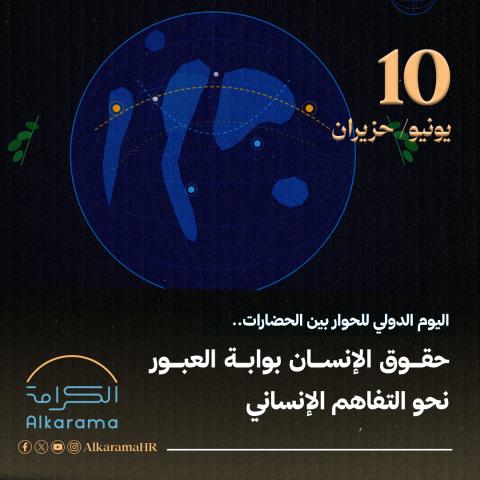
By its resolution No. A/RES/78/286 adopted on 7 June 2024, the United Nations General Assembly proclaimed 10 June as the International Day for Dialogue among Civilisations, “to raise awareness of the value of the diversity of civilisations and to encourage dialogue, mutual respect, tolerance and global solidarity.” This day seeks to replace the narrative of the “clash of civilisations” with that of an “alliance of civilisations” grounded in constructive dialogue between peoples.
In a context marked by the worsening of global tensions, cultural misunderstandings, the rise of nationalism, ideological extremism and geopolitical conflicts, the observance of this day is of particular importance. However, the position adopted by the majority of governments regarding the situation in Gaza as well as the silence observed in the face of Israeli military operations and the suffering inflicted on the Palestinian people illustrate the profound gap between the aspirations upheld by the United Nations and the realities on the ground.
In light of these findings, it should be recalled that the International Day for Dialogue among Civilisations must not be limited to a symbolic commemoration but should serve as a call to action to give concrete effect to its underlying objectives. Governments must support policies and initiatives that promote intercultural understanding and work towards the establishment of international relations based not on the logic of power but on the principles of justice, equality between peoples, respect, and the safeguarding of human dignity and fundamental rights for all.
From this perspective, Alkarama considers that genuine dialogue among civilisations can only rest on solid foundations if it is accompanied by a sincere and effective commitment to the respect of human dignity and the protection of fundamental rights, irrespective of cultural identity, religious affiliation or geographical location. Human dignity is neither a divisible principle nor a right reserved for some peoples at the expense of others; it constitutes the foundation of shared human values that bring societies closer together and foster coexistence.
Alkarama and the Promotion of Justice and Dialogue
Since its establishment in 2004, Alkarama has worked to act as a genuine bridge between victims of human rights violations in the Arab world and the international human rights protection mechanisms. Its work is based on the principle of full and equal treatment of all victims without distinction based on origin, religion, gender or nationality.
This commitment has led Alkarama to submit thousands of communications and complaints to United Nations treaty bodies, Special Procedures, and the Working Group on Enforced or Involuntary Disappearances, convinced that international human rights law loses its meaning when its principles are applied selectively to serve political considerations or particular interests at the expense of justice.
In the same vein, Alkarama believes that the responsibility for dialogue among civilisations does not rest solely with peoples but falls primarily upon States and governments which have under international law, clear obligations enshrined notably in Article 1 of the Charter of the United Nations and the Preamble of the Universal Declaration of Human Rights, aimed at preserving human dignity worldwide and working to eliminate the root causes of tension, hatred and feelings of superiority between civilisations.
Cultural diversity cannot imply tolerance for impunity and no dialogue can be fruitful when conducted in a context of ongoing violations of peoples’ rights to life and self-determination. It is also essential to recall the risks associated with an approach that empties the concept of dialogue among civilisations of its human rights dimension, turning it into a selective discourse used to legitimise existing realities rather than contributing to their transformation. The dialogue promoted by the United Nations can only be genuine when it is based on the principle of equality between parties and when every individual enjoys the right to speak to challenge, to defend a cause and to seek justice without fear of repression or persecution—rights expressly guaranteed under international human rights law.
In this context, Alkarama reaffirms the responsibility of States, particularly in the Arab world to put an end to restrictions on civic space and to the prosecution of human rights defenders, journalists and activists who call for accountability and an end to violations.
Dialogue among civilisations cannot flourish in an environment where voices calling for justice are silenced and where those who bear witness to violations or report crimes before United Nations mechanisms are subjected to pressure, reprisals or persecution.