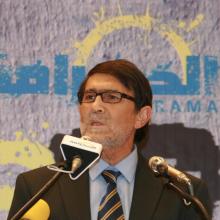
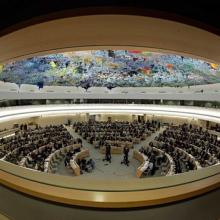
On the occasion of World Press Freedom Day, celebrated globally on 3 May, Alkarama wishes to highlight the cases of the following activists, whose right to freely exercise their profession of journalists has been violated. Far from being exhaustive, this list wants to raise awareness of the general public on those cases by providing a brief overview of the phenomenon in some specific countries.

Algeria: A TV Show Closed for Denouncing Corruption

At the launch of its annual report in Geneva on 26 March, Alkarama chastised Arab States for trying to undermine, not only the United Nations human rights system, but also Arab civil society, all this under the pretext of countering terrorism, a label that has become the weapon of choice for authoritarian regimes to stifle criticism.
On 20 March 2015, UPR Info and a group of 46 NGOs, including Alkarama, called upon UN Member States to focus on the quality and not the quantity of recommendations issued during the Universal Periodic Review (UPR), which should be stronger and more specific.

ABOUT ALKARAMA

On 16 September 2014, the members of Alkarama's legal department met with the experts of the Working Group on Enforced or Involuntary Disappearances (WGEID) to express their main concerns about the growing problem of enforced disappearances in the Arab world.

In his last report to the Human Rights Council, Secretary General Ban Ki-moon raised cases of retaliation against persons who have cooperated with the United Nations, ranging from threats, travel bans, arbitrary detention and torture, which he says are only the "tip of the iceberg".

In this article, Alkarama responds to the recent false accusations of supporting terrorism on behalf of Qatar, allegations peddled by Lebanese daily, As-Safir and echoed in other "news" sites in the region.

Nominations for the 2014 Alkarama Award for human rights defenders are now closed. Thank you for having been so many to send in your candidates from 16 different Arabic countries.

Alkarama addresses the most serious human rights violations, i.e. violations which relate to the right to life, human dignity, physical integrity and freedom. The idea behind Alkarama's specific mandate is that only when citizens are free from the most serious human rights abuses that individuals can freely and effectively call for all of their rights and ensure the rule of law in their countries.

FAQ

What makes the work of Alkarama unique?

  • We work directly with the victims of human rights violations and their families
  • The victims and the first hand information they provide are at the centre of our work
  • We work mainly with the UN human rights system
  • We work on four priority areas: extrajudicial executions, enforced disappearances, torture, and arbitrary detention.
  • We are a trilingual organisation